See how Pactum's Requisition Alignment Agent checks every purchase requisition against your policies before the PO, so spend stays compliant, on contract, and audit-ready.
Why can’t we align requisitions with procurement strategy at scale?
Every purchase requisition comes with a quiet to-do list.
Are the supplier’s contact details right? Has the quote been confirmed? Do the payment terms match the contract? Is the price in line with the rate card? Has the right person signed it off?
And that list only ever gets longer. Every new financial control, savings target, audit requirement, or sustainability obligation adds another check.
In a large enterprise, a single request can face 50 to 70 individual checks. Now imagine doing that for hundreds of requests every week, with the same team and the same number of hours in the day.
Take one reviewer handling 500 purchase requests a week. By Thursday afternoon, the queue is still growing. Another request comes in. Then another. Each one needs attention, and the next one is already waiting.
Meanwhile, someone is waiting for new equipment. A project is stuck waiting for a purchase to go through. A buyer is chasing an approval that’s been sitting in the queue for days.
And guess who gets the blame when things don’t move? Procurement.
Look closely at how requisition review works today, and you’ll start to see the same problems coming up:
- The threshold gap
To keep up, many teams only review requests above a certain value, so a big share of everyday spend is never checked against policy at all.
- Requests that arrive incomplete
A wrong GL code, a missing quote, a supplier that isn't set up. Someone has to chase every gap before the request can move.
- Value that leaks out quietly
A quote with 30-day payment terms when your standard is 90, a price just above the rate card, or a laptop bought from a different supplier when you already have a deal. Each one looks fine at a glance, so it goes through.
- Decisions that depend on who's reviewing
The same policy gets applied differently across teams and regions. One request gets approved, an identical one gets sent back, and perfectly valid requests get rejected because a busy reviewer played it safe.
- Queues that push people to work around procurement
When a request sits for days, employees find another way to buy, choosing their own supplier or putting it on a card.
- Problems that surface too late, with no record of why
Issues caught after approval or during sourcing send requests back and forth, and when audit asks why a purchase went through, nobody can say.
Your buyers know your policy inside out. The challenge is that no team can give dozens of checks to every single request, every single day, and still have time for strategic work.
Why do requisitions keep getting rejected after initial approval?
It’s one of the most frustrating moments in procurement. A request gets approved, everyone moves on, and days later it bounces back.
That happens because approval and compliance are two different checks. When a manager or budget holder approves a request, they’re answering one question: do we need this, and can we afford it? They’re not buyers, and nobody expects them to open the contract, check the supplier record, or compare the quote against the rate card.
Those checks happen later, and sometimes not until after the PO has been raised. That’s when the problems appear:
- Attachments are missing or wrong, so the request can’t be properly checked.
- There’s no contract link, so nobody realises you already have a negotiated deal with someone else.
- The quote doesn’t match the request, or the payment terms and pricing don’t match what was agreed.
- It should have been sourced, because a purchase that size needed three quotes or a competitive bid.
Now everyone pays for it. The requester has to start again and feels like procurement is blocking them. The buyer spends the afternoon chasing details. The business waits another week for something it thought was sorted. And if an issue slips through anyway, it’s often only spotted after the PO is raised, when it’s much harder to fix.
And because these fixes often happen over email or a quick call, there’s no record of what was wrong or why the request was finally approved.
What procurement platforms offer requisition alignment features?
Most procurement platforms offer some form of requisition checking. Coupa and SAP Ariba route requests to the right approver and make sure the required fields are filled in. Intake and orchestration tools have made requests much easier to submit, and many now come with AI that summarises requests, suggests a category, or flags something that looks off.
But there are two types of AI in procurement: AI that helps you work, and AI that does the work. Most of what sits in today’s P2P and intake tools is the first kind. It recommends, routes, and highlights, and then hands the request back to your team to deal with.
So follow a requisition after it’s submitted, and you’ll find your team still doing the checks that matter most:
- Your team still reads the quote against the contract
Someone has to open both and compare the terms line by line.
- Your team still checks the commercials
Pricing against the rate card, payment terms against what was agreed, and whether there's a contract the request should be bought against.
- Your team still applies the strategy
Does this request follow category strategy? Does it need three quotes or a competitive bid?
- Your team still explains the decision
Why it said yes or no, if anyone writes it down at all.
Workflows decide who should review a request. AI that helps you work tells you what to look at. Neither actually does the review.
What if every requisition arrived complete and compliant, before anyone in procurement even had to look at it?
What is a Requisition Alignment Agent?
Pactum’s Requisition Alignment Agent is an AI agent that checks every purchase requisition against your procurement policies, contracts, approved suppliers, and data standards before a purchase order is raised.
Think of it as a reviewer who knows your whole policy by heart and never runs out of time. It gives every request the same careful check, whether it’s the first one of the day or the five hundredth, and whether it’s for £500 or £500,000.
The difference is what happens next. Instead of flagging a problem and leaving it on someone’s desk, the agent fixes what it can and tells the requester exactly what to change. So by the time a request reaches your team, it’s already complete and compliant, or it’s a genuine exception that needs a buyer’s judgement.
It works inside the P2P system you already use, including Coupa and SAP Ariba, and it’s built for large enterprises handling high volumes of indirect requisitions.
- <1 min
- to check a request against every policy you have
- 99%
- agreement with a customer's own reviewers before it acted alone
 Webinar60s to check every requisition with Pactum's AI agents: Every requisition checked in just 60 seconds
How do you validate purchase requisitions before they reach procurement?
Most procurement policies don’t live in one place. They’re spread across PDFs, category strategies, approval matrices, and the know-how in your buyers’ heads. And whether your team checks every requisition against 15 policies or 70 individual rules, doing it by hand doesn’t scale.
The Requisition Alignment Agent brings all of that together into one rulebook, then applies it to every request, in five steps:
Build the rulebook
The agent reads your existing policy documents and category strategies, turns them into rules, and asks your team about anything that's unclear or missing. You don't need a perfectly written policy to get started, and your team approves every rule before it goes live.
Check every request
The moment a requisition is raised, the agent checks it against the rulebook. Every request, every time, with no value threshold and no sampling:
Data and coding: Is the category, GL code, and cost centre right, and is every required field filled in?
Supplier: Is the supplier approved and properly set up?
Contract and pricing: Is there a contract this should be bought against? Do the price, payment terms, and quote match what was agreed?
Policy and approvals: Has the right person signed it off? Does it need three quotes or a competitive bid?
Risk: Are there any sanctions or supplier compliance concerns?Fix or explain
Simple issues, like a wrong category or a missing contract link, are corrected on the spot. Anything the agent can't fix goes back to the requester with a clear reason and exactly what to change.
Hand on to negotiation
Clean requests move straight on to Single-Source Negotiation or Tactical Sourcing, so savings can be captured before the PO is raised.
Straight to PO
The purchase order is raised in your P2P system, and every check and decision is logged there, along with the rule behind it.
The whole review takes under a minute. And because every one of Pactum’s AI agents follows the same rulebook, the policy that checks a requisition is the same policy that guides the negotiation.
Which procurement platforms offer AI-powered requisition intake and alignment?
Pactum does both, and the two work together. You can now skip the intake form entirely. With Pactum’s newest AI agent, the Intake Agent, anyone in your business can simply say what they need, and the requisition is created for them.
No forms, no codes, and no need to know how procurement works. Just a message in Microsoft Teams, Coupa, or SAP Ariba, like “I need 20 laptops for the new sales team” or “We need to renew our design software.”
From there, Pactum’s AI agents take it all the way to a purchase order:
How it works
From request to PO, agent to agent
- Intake AgentCreates the requisition, complete, correctly coded, and linked to the right supplier and contract.
- Requisition Alignment AgentChecks it against every policy, with issues fixed on the spot.
- Negotiation agentsNegotiate a better price with the supplier, or run a competition.
Purchase order
The PO is raised right in your P2P system.
- The Intake Agent creates the requisition - complete, correctly coded, and linked to the right supplier and contract.
- The Requisition Alignment Agent checks it - against every policy, with issues fixed on the spot.
- Pactum’s AI agents negotiate a better price - with the supplier or by running a competition.
- The purchase order is raised - right in your P2P system.
This is what we call Autonomous Procurement: AI agents that run the buying process for you, from the moment someone asks for something to the moment the purchase order is raised.
Free eBookWhat is Autonomous Procurement?How AI agents run the buying process end to end, within the strategy and guardrails procurement sets.Read the eBook
Think of it as a relay. Each AI agent picks up where the last one left off. One creates the requisition, the next checks it, another negotiates with the supplier, and the last raises the PO. The request never sits in a queue waiting for someone to pick it up, so it keeps moving until it’s done, usually in under a day.
And your team stays in charge the whole way. Procurement sets the rules and the strategy, and steps in only when a decision really needs a human. The AI agents simply do the work in between.
What are the benefits of a Requisition Alignment Agent?
Once compliance takes care of itself, the benefits start to add up across the whole business.
Here’s what that looks like for procurement teams running Pactum’s Requisition Alignment Agent today, including SUEZ, who are handling more than 100,000 requisitions a year.
Product tourSee how the Requisition Alignment Agent works in Coupa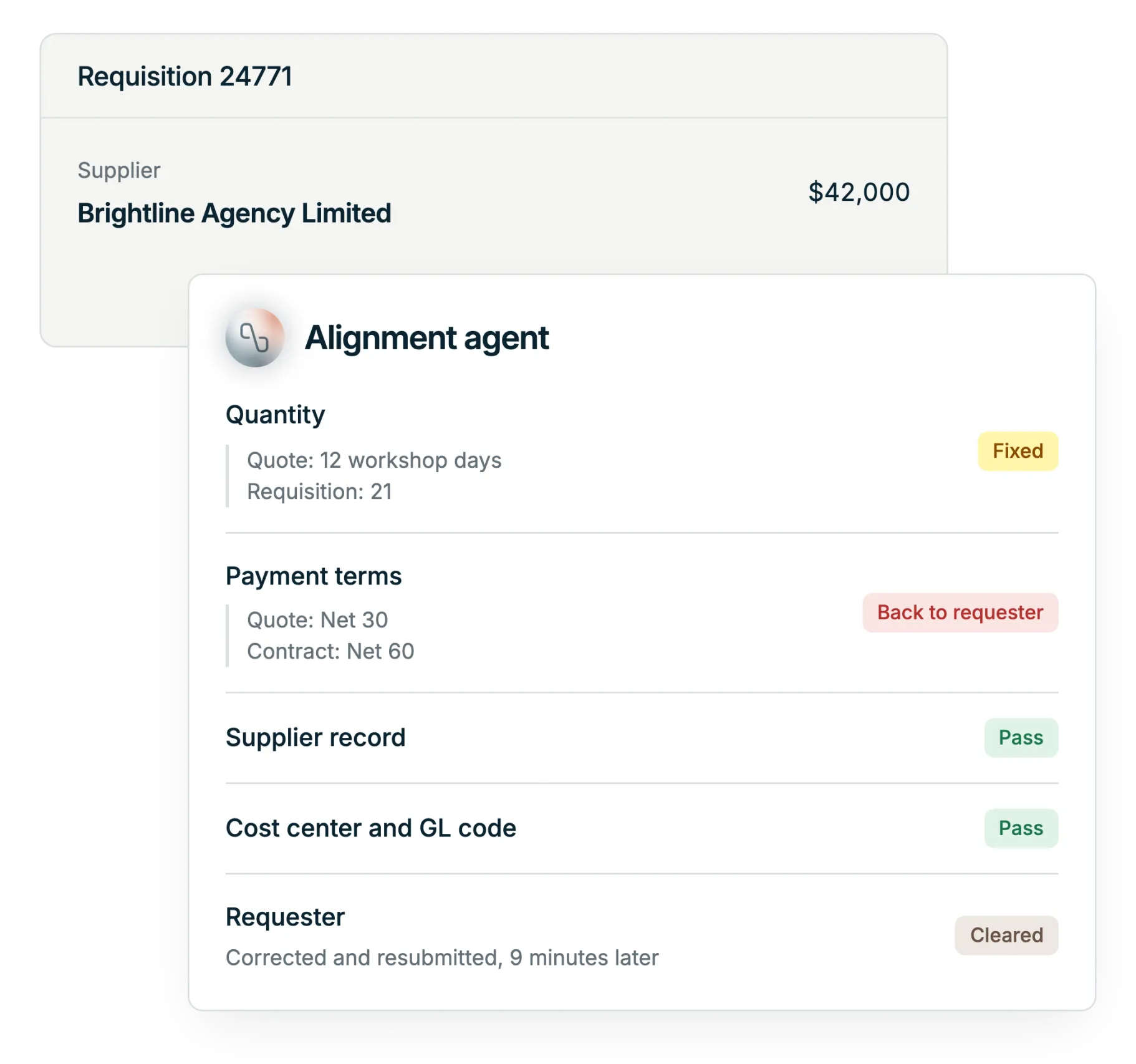
Procurement stops being the bad guy
Let’s be honest, when things don’t move, procurement gets the blame. Requests sit in a queue for days, employees keep chasing for updates, and some give up altogether and buy it themselves with their own supplier or a company card. Hello, maverick spend.
It gets worse when compliance checks take longer than the actual sourcing. With Pactum, every request is checked the moment it’s raised. Reviews that used to take 2 to 4 days now take under a minute, so employees get a clear answer straight away and clean requests keep moving.
Pactum has already completed more than one million requisition checks, and that’s a lot of employees who didn’t have to chase procurement for an answer.
Suddenly, procurement is the team everyone wants to work with.
100% policy checks: how AI improves buying compliance in indirect procurement
Thresholds, spot checks, and the 4pm Friday “looks fine to me” review all leave gaps. And let’s face it, most approvers were never checking policy in the first place. They were just confirming someone really does need that new monitor.
This is how AI improves buying compliance in indirect procurement: every request, every rule, every time. The Requisition Alignment Agent checks 100% of purchase requisitions against your policies, contracts, approved suppliers, and data standards, whether it’s a box of pens or a major services contract. No favourites, no shortcuts, no “I’ll check that one later.”
And it works both ways. Off-policy requests get caught, and perfectly good ones stop getting bounced by a busy reviewer playing it safe. Requesters are told exactly what to fix, so they get it right the first time. That’s why teams see 80% fewer rework loops, and a lot fewer “why was mine rejected?” emails.
Stop paying full price for everyday purchases
Thousands of everyday purchases go straight to PO at the supplier’s quoted price, simply because nobody has time to look at them. Add in off-contract buys and payment terms that quietly drift from what was agreed, and that money adds up fast.
The Requisition Alignment Agent catches these before the PO is raised and steers spend back to your preferred suppliers and contracts, so the prices you negotiated actually get used. Then Pactum’s AI agents take it further, negotiating with the supplier or running a competition wherever there’s room to do better. No more wasting your team’s time on low-value supplier deals.
Across customers, requests negotiated this way have delivered 1 to 15% savings on spend that used to go straight to PO. Find out how agentic negotiations work.
 Customer story · Honeywell$65K saved in one negotiation: How Honeywell saved $65,000 in a single negotiation, with no human involvedSee how Honeywell did it
Give your buyers their time back
Your buyers are some of the most commercially skilled people in the business. Yet as requisition volumes grow, more and more of their week goes on checking codes and chasing quotes, leaving you with two expensive options: hire more reviewers or outsource the work.
Pactum gives you a third option. Let AI agents take on the routine review work, and your team only steps in on the exceptions that really need their judgement. That’s how AI agents reduce manual work in indirect procurement.
Global 2000 teams have seen 99% less manual review effort and more than 20% of buyer capacity freed. That’s a fifth of the week back for sourcing, supplier relationships, and strategy. It’s how teams scale procurement without adding headcount and stop spending their best people on clearing queues.
 Customer story · SUEZ80% of manual review time eliminated: How Pactum’s AI Agents Support SUEZ in Eliminating Manual Requisition ChecksRead the SUEZ story
The audit trail your finance team will love
We’ve all been there. Finance pings you with “quick question, why did this purchase go through?” and suddenly you’re three months deep in email threads, trying to remember a phone call nobody wrote down.
With Pactum, you can skip the detective work. Every check, fix, and decision is logged against the rule behind it, right inside Coupa or SAP Ariba, so you never lose visibility into a single requisition. The answer to “why was this approved?” is always on record and always one click away.
Finance gets spend that stays on contract and on terms. Audit gets evidence for every single decision. And you get to answer both in seconds, without a single “let me get back to you on that.”
Manual review vs. a Requisition Alignment Agent: what changes for your business?
So how much time does your procurement team actually waste on manual requisition validation and compliance checks? When every review is done by hand, a single request can sit for up to 4 days while someone finds time to check it.
With the Requisition Alignment Agent, every request gets a full policy check in minutes, and your team does 99% less of the manual work. Not bad, right?
| Manual requisition review | Pactum’s Requisition Alignment Agent | |
|---|---|---|
| Review time | 2 to 4 days per request, waiting in a queue | 2 to 4 minutes, checked the moment it’s raised |
| Manual effort | Buyers check every request by hand | 99% less manual review effort |
| Policy coverage | Small requests often skip review because of value thresholds | 100% of requests checked, with no threshold or sampling |
| Rework | Requests bounce back and forth over missing or wrong details | 80% fewer rework loops, because requesters are told exactly what to fix |
| Buyer capacity | Buyers spend their time validating requests | 20%+ of buyer capacity freed for negotiation and sourcing |
| Savings | Off-contract buys and mismatched payment terms slip through to PO | Caught before the PO and handed on to negotiation |
| Audit trail | Decisions sit in emails and offline conversations | Every check and decision logged with the rule behind it in Coupa or SAP Ariba |
| Scale | More requests means hiring more reviewers | More requests handled without growing your review team |
Source: Pactum’s blog post What If Every Purchase Requisition Arrived Complete and Compliant?
What guardrails should procurement set before AI agents act alone?
Handing requisition review over to AI can feel like a big step. That’s why Pactum doesn’t ask you to hand over control on day one. You roll it out gradually, build trust step by step, and you decide when the agent is ready for more.
Step 1
Observer mode
The agent checks real purchase requests in the background while your team works as usual. Once it reaches 99% agreement with your reviewers' decisions, you move on to Stage 2.
Step 2
Advisor mode
Now the agent becomes your reviewers' second pair of eyes. Every requisition arrives with the agent's findings already attached: what it checked, what it flagged, and why. Your reviewers still make every decision, but they're no longer starting from scratch, so reviews that took hours take minutes.
Step 3
Greater autonomy
Once your team trusts the agent's calls, it starts handling routine reviews on its own, along with routing requests and escalating problems. Your team focuses on the exceptions and the decisions that need human judgement.
You can move each rule, category, or region through these stages at its own pace, and roll back at any time.