By Pactum · · Updated · 9 min read
TL;DR
If you only have 30 seconds, here’s a recap:
-
Most suppliers are never negotiated with at all. Negotiation has always been the most human part of procurement, and while teams have spent years perfecting high-stakes deals, no team has the capacity to engage thousands of suppliers continuously, so the vast majority of the base goes untouched.
-
AI can genuinely negotiate, and it does so inside your rules. Pactum’s AI agents run up to 10,000 supplier negotiations simultaneously, drawing on supplier data, benchmarks, historical outcomes, and market signals, while operating within guardrails your team defines before a single conversation starts.
-
Suppliers often prefer it. Walmart, already running autonomous negotiation at scale, found that 85% of suppliers would rather negotiate with a bot than a human, and the fastest Pactum negotiation closed in just 87 seconds.
-
Buyers stay firmly in charge. The agents escalate the moment human judgment is needed, and buyers retain full visibility into the reasoning, arguments, and decisions behind every negotiation while they focus on strategy, relationships, and the complex deals that need them.
-
Negotiation is one piece of a bigger shift. The same intelligence runs across the entire procurement lifecycle, from validating requisitions at intake to preparing strategic negotiations, at a scale manual processes were never designed to reach.
Traditional negotiations were never built to scale
Negotiation has always been considered the most human part of procurement, built on judgment, relationships, timing, and trust. So when procurement leaders first hear about AI agents negotiating autonomously with suppliers, two questions come up in almost every conversation.
Can an AI be trusted to negotiate on our behalf without making the wrong call, damaging a supplier relationship, or going outside the boundaries we’ve set?
And if agents are negotiating autonomously, what’s left for my buyers to do?
Both questions deserve a serious answer, and both rest on a common misconception, which is that AI is trying to replace how procurement works today. In reality, it’s solving the work procurement teams never had the capacity to cover in the first place.
While teams have spent years refining high-stakes negotiations, a larger problem has continued to grow in the background: most suppliers are never negotiated with at all, simply because no team can engage thousands of suppliers continuously.
That is the problem worth solving, and it’s the one agentic AI was built for.
When capacity runs out
AI doesn’t compete with how procurement already works. It fills the gap where human capacity ends, picking up the work that was never going to get done, and in most organizations that gap is wide:
-
Most suppliers are never negotiated with - Large portions of spend sit entirely unmanaged, with agreements that no buyer has ever challenged or even reviewed.
-
Pricing and terms are rarely revisited - Contracts drift out of line with market conditions because the conversation to realign them never gets scheduled.
-
Spend is fragmented across teams and business units - Volume that should create leverage and rebate potential stays scattered, and nobody has the capacity to consolidate it.
-
Buyers stay buried in operational work - The people hired to drive commercial value spend their days chasing requisitions and follow-ups instead.
None of this reflects a skills gap. Procurement teams already know how to negotiate, and they prove it every day in the deals they do get to. The only thing missing is the capacity to bring that same rigor to thousands of suppliers at once.
So can AI actually negotiate?
Yes, and it does what no procurement team can do on its own: run 10,000 supplier negotiations simultaneously, around the clock, without adding a single headcount.
Forget the image of a chatbot making offers and hoping for the best. AI negotiation is a structured system that uses supplier data, benchmarks, historical outcomes, and market signals to execute negotiations autonomously across your supplier base, adapting in real time to supplier responses while operating within procurement-defined guardrails.
Before any supplier conversation begins, your team defines the commercial rules, pricing thresholds, term ranges, category policies, and negotiation strategies the system can operate within, and from there it executes consistently at scale:
-
Stays inside approved boundaries - Every negotiation operates within the commercial and compliance limits your team has set, in every exchange, with every supplier.
-
Adapts in real time - Supplier interactions respond dynamically to what the supplier says while always following procurement-defined logic.
-
Escalates immediately when needed - The moment a negotiation calls for human judgment, it moves to a buyer rather than being decided by the agent.
-
Keeps buyers in full view - The reasoning, arguments, and decisions behind every negotiation are visible and explainable, so nothing happens in a black box.
Automating one negotiation saves a buyer an afternoon. Automating every negotiation transforms procurement from a function limited by headcount into one limited only by strategy.
Before and after AI negotiation
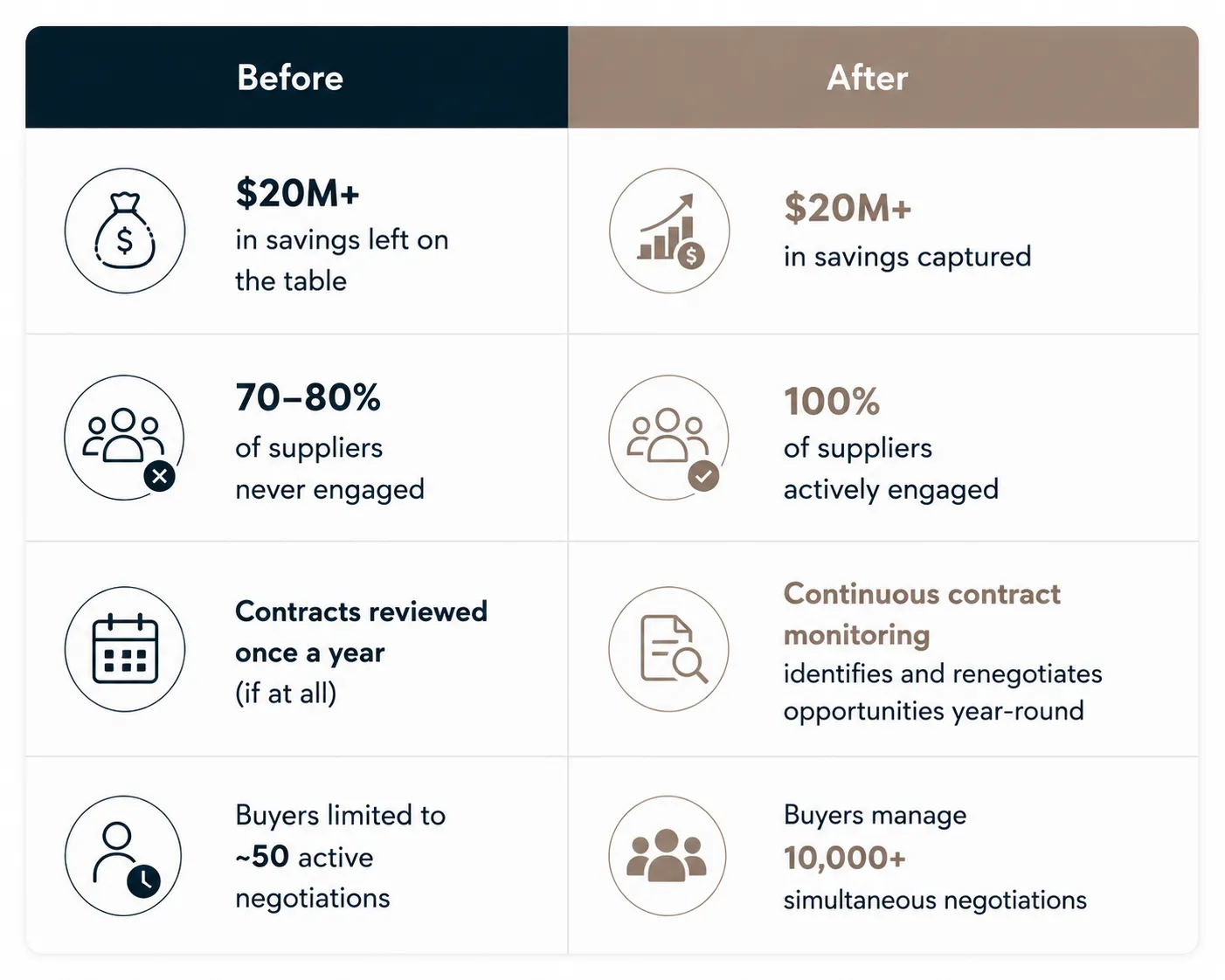
Here is how supplier coverage changes when AI agents take on the negotiation volume your team never had the capacity to reach.
| Measure | Before AI negotiation | With Pactum’s AI agents |
|---|---|---|
| Savings | $20M+ left on the table | $20M+ captured |
| Supplier coverage | 70 to 80% of suppliers never engaged | 100% of suppliers actively engaged |
| Contract reviews | Once a year, if at all | Continuous monitoring that finds and renegotiates opportunities year round |
| Negotiation capacity | About 50 active negotiations per buyer | 10,000+ simultaneous negotiations |
Trust is built in before the first conversation starts
The trust question is the right one to ask, and the answer sits in the sequencing. The agents never decide what your commercial strategy is, they execute the strategy your team has already defined, within thresholds your team has already approved, and anything that falls outside those boundaries escalates to a human immediately.
Every action is tracked and every outcome is explainable, which means the control procurement leaders worry about losing is exactly what the system is designed around.
Suppliers often prefer negotiating with AI
Walmart, already running autonomous negotiation at scale, found that 85% of suppliers would rather negotiate with a bot than a human. For suppliers, the experience feels natural, like chatting with a person, just faster, more consistent, and available in any language.
There’s no tension, no pressure, and no emotion shaping the outcome, suppliers who are usually ignored finally have a structured way to engage, and every supplier is treated the same, with clear rules and equal footing regardless of size or spend.
For procurement teams, the impact shows up almost immediately: suppliers respond faster, engagement rates climb, and negotiations that would normally sit in inboxes for days start closing in minutes. The fastest Pactum negotiation closed in just 87 seconds.
Your buyers finally get to do the job they were hired for
When the backlog moves to agents, your team moves forward. Buyers were hired to drive strategy and supplier value, and AI creates the space for that work to happen by taking on the volume that has always held them back. Procurement becomes the engine of your supply chain, running continuously across the entire supplier base, guided by your strategy and executed at a scale your team alone could never reach.
If AI can negotiate, what does procurement look like next?
For the first time, procurement teams are no longer limited by how much they can cover. Every supplier is commercially managed, every contract is reviewed before renewal, and every pricing opportunity is within reach.
And negotiation is just one place where this intelligence works, because Pactum’s AI agents operate across the entire procurement lifecycle:
-
Requisition Alignment agents make sure every purchase request arrives complete, compliant, and commercially aligned before supplier engagement begins, so execution scales without adding risk.
-
Campaign agents renegotiate payment terms, rebates, and prices across thousands of suppliers at once, capturing value no manual process could reach.
Buyers lead the strategy while agents handle execution continuously across the supplier base. Early adopters have recognized that the capacity constraint was never going to solve itself, and that the technology to remove it has arrived.
See AI negotiation in action
Book a demo to see how Pactum’s AI agents negotiate autonomously within the guardrails you define, helping you manage every supplier, capture more value, and free your buyers to focus on the work that matters most.