By Pactum · · 8 min read
TL;DR
If you only have 30 seconds, here’s a recap:
-
Most of your supplier base is never negotiated with. On average, 70 to 80% of suppliers sit entirely outside active commercial management, because procurement teams run out of hours long before they run out of suppliers worth negotiating with.
-
The losses are quiet, but they compound. Contracts roll over at last year’s terms, price lists drift upward with no one reviewing them, and payment terms stay short, quietly tightening cash flow cycle after cycle.
-
Pactum’s AI agents can run 10,000 supplier negotiations simultaneously, around the clock, handling every step from first contact to closed agreement inside guardrails your team defines.
-
Agentic negotiations deliver up to 15% savings on previously unmanaged spend, execute in minutes what once took weeks, and keep an audit trail along the way.
-
Your procurement team can finally focus where they matter most. Buyers set the strategy and lead the complex negotiations where human judgment makes all the difference, while the agents handle a volume no team could reach alone.
The negotiations that never happen
Procurement teams are delivering more than ever. Cycles are getting faster, negotiations are being fought harder, and savings targets keep getting hit. And yet, behind every strong procurement result sits a longer list of conversations that never happened, suppliers that were never negotiated with, and contracts that quietly rolled over because the team simply ran out of hours.
The top vendors get the attention, the high-value contracts get reviewed, and everything else gets rescheduled, quarter after quarter, while the commercial opportunity sits there untouched. The scale of that gap is larger than most organizations realize.
On average, 70 to 80% of a supplier base sits entirely outside of active commercial management, and it stays there because no team of buyers, however skilled, can be at 10,000 tables at once.
This has always been the defining constraint of enterprise procurement. For the first time, there is a solution built to match it.
What it costs when suppliers never hear from you
Every supplier conversation you don’t have comes with a cost. Most organizations don’t notice it at first. But across hundreds or thousands of suppliers, automatic renewals, small price increases, and unchanged payment terms quietly compound into millions:
-
Contracts roll over at last year’s terms - Agreements renew automatically because no one had the hours to get to the table, and every rollover locks in conditions the market may no longer support.
-
Price lists drift upward - Small increases accumulate year after year with no buyer ever reviewing them, quietly resetting the baseline for every future negotiation.
-
Payment terms stay short - The conversation to extend terms never gets scheduled, and working capital tightens cycle after cycle without anyone deciding it should.
-
Suppliers set the conditions - When procurement never opens the negotiation, the supplier’s terms become the default, and the longer that continues, the harder those terms are to unwind.
None of this happens because teams lack the skill. Buyers already know exactly what they would push for in every one of these conversations. The only thing missing is the time to have them, consistently, across thousands of suppliers at once.
Meet the AI agents that negotiate with every supplier
Agentic negotiations do what no procurement team can do on its own: run 10,000 supplier negotiations simultaneously, around the clock, without adding a single headcount.
From first contact to closed agreement, Pactum’s AI agents handle every step of the commercial cycle without a buyer needing to be in the room:
-
Identify the opportunity - Scan every supplier segment, category, and dormant contract to find where commercial value is sitting unclaimed.
-
Open negotiations at scale - Contact every supplier directly and simultaneously, on your timeline, whether that means fifty renewals or ten thousand.
-
Handle responses in real time - Apply your pricing logic, payment terms, and category rules consistently in every exchange, at any hour, with any supplier.
-
Close or escalate - Finalize agreements within the parameters you set, and escalate the moment a negotiation needs human judgment.
The entire process runs inside guardrails your procurement team defines before a single negotiation starts, and every action is tracked and every outcome explainable.
Imagine Every Supplier Negotiated
Negotiating one overlooked contract recovers one agreement’s worth of value. Negotiating every overlooked contract transforms how procurement operates.
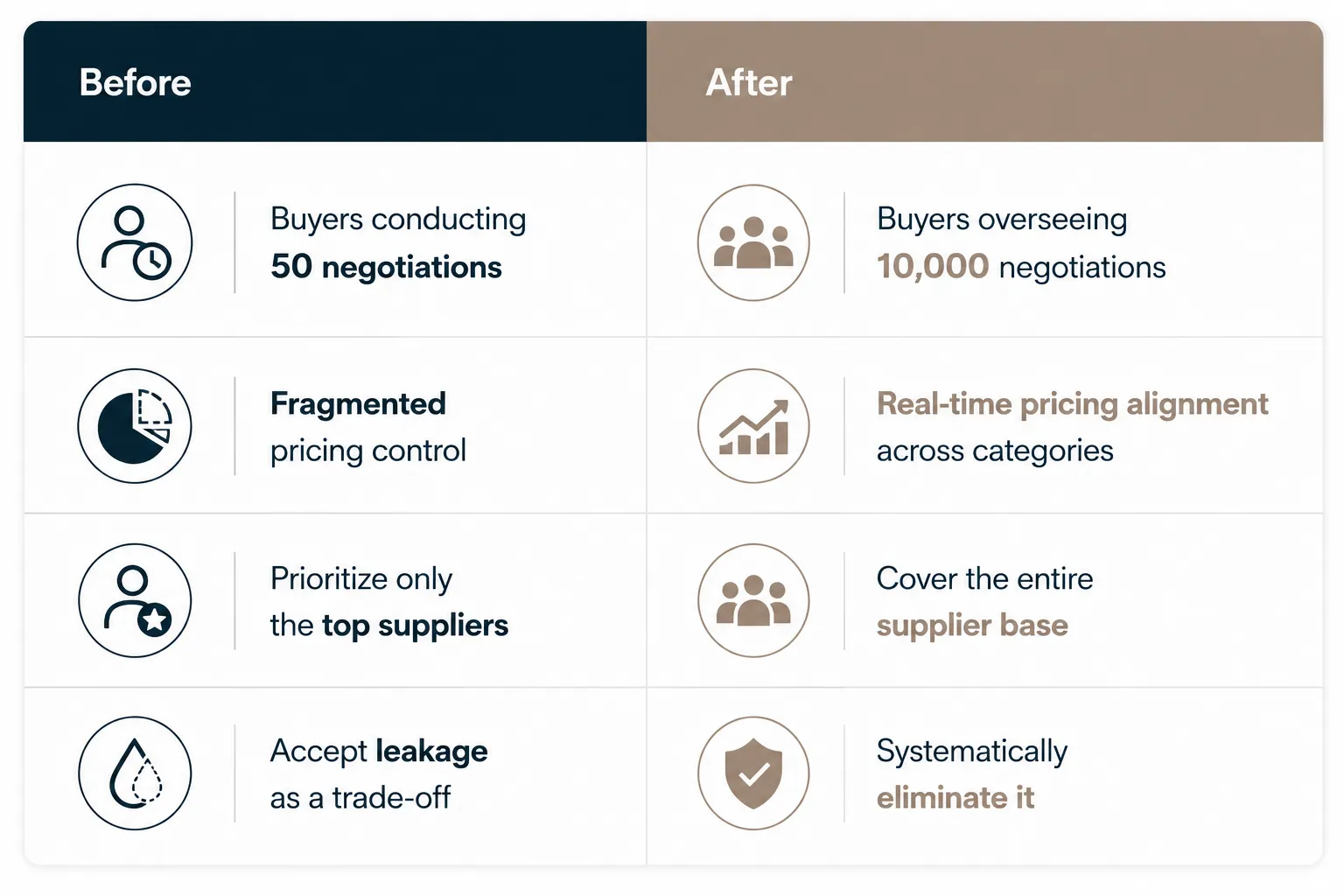
Negotiate with every supplier, not just the strategic few
When every negotiation demands a buyer’s time, teams have no choice but to focus on the vendors at the top of the list, and the rest of the base runs on autopilot.
Agentic negotiations remove that trade-off. Renewals are handled, routine price checks run continuously, and supplier follow-ups progress without anyone needing to chase them, so for the first time, every supplier in the base is within reach regardless of how many buyers are on the team.
Turn unmanaged spend into measurable savings
The spend nobody negotiates is where value leaks fastest, and it’s also where agentic negotiations deliver their clearest results, capturing up to 15% savings on previously unmanaged spend.
Because the agents run 24/7, they execute in minutes what once took weeks.
Move Buyers Up the Value Chain
Buyers are no longer defined by the volume they can personally manage. They become the architects of a commercial engine that runs continuously, consistently, and at a scale that simply wasn’t possible before, and their expertise finally goes where it belongs: shaping strategy, strengthening supplier relationships, and leading the complex negotiations where human judgment makes all the difference.
The new operating model for procurement
Negotiation at scale is one part of a much bigger shift. The same intelligence that closes agreements with thousands of suppliers also works across the entire procurement lifecycle, and Pactum’s AI agents cover every stage of it:
-
Requisition Alignment agents validate every purchase request at intake, checking for policy compliance, contract linkage, and commercial accuracy before anything moves forward.
-
Campaign agents renegotiate payment terms, rebates, and prices across thousands of suppliers at once, capturing value no manual process could reach.
The real question procurement leaders are starting to ask is how much value is sitting in their supplier base that their team has simply never had time to reach. The answer has always been the same.
What has changed is the ability to go get it, across every supplier, every category, and every contract, simultaneously and at scale.
See how Pactum’s AI agents put every supplier in your base within reach
The 10,000 conversations your team never had time for are finally happening.
Frequently Asked Questions
What are agentic negotiations in procurement?
Agentic negotiations are supplier negotiations run autonomously by AI agents, from first contact to closed agreement, inside guardrails the procurement team defines in advance. The agents identify commercial opportunities, open negotiations with suppliers directly, handle responses in real time, and close agreements within set parameters, escalating to a buyer whenever human judgment is needed.
Can AI really negotiate with suppliers on its own?
Yes. Pactum’s AI agents conduct complete negotiations with suppliers, applying the pricing logic, payment terms, and category rules the procurement team has defined, and they do it consistently across thousands of suppliers at once. Anything that falls outside the agreed parameters is escalated to a buyer rather than decided by the agent.
What is the biggest benefit of agentic negotiations?
Scale. On average, 70 to 80% of a supplier base sits outside active commercial management because teams run out of hours, and agentic negotiations bring all of it within reach, delivering up to 14% savings on previously unmanaged spend while running around the clock.
Why do so many suppliers go unnegotiated today?
Every negotiation takes a buyer’s time to prepare, conduct, and close, so teams naturally focus on the largest vendors and highest-value contracts. Everything else gets rescheduled quarter after quarter, contracts roll over at existing terms, and the commercial opportunity in the rest of the base goes uncaptured.
How do procurement teams stay in control of what the agents agree to?
The procurement team defines the guardrails before a single negotiation starts, including acceptable price ranges, payment terms, and category rules. Agents only close agreements within those parameters, everything outside them is escalated to a human, and every action is tracked so every outcome can be audited and explained.
Do agentic negotiations replace buyers?
No. The agents take on the volume that has always held teams back, and buyers move up to the work where they create the most value: setting strategy, managing supplier relationships, and leading the complex negotiations where human judgment matters most.
Which suppliers are agentic negotiations best suited for?
They deliver the most immediate value across the long tail: tail-spend renewals, routine price reviews, payment term updates, and dormant contracts that would otherwise roll over untouched. Strategic negotiations stay with your experienced buyers, supported by the evidence and preparation Pactum’s other agents provide.
Are supplier negotiations the only use case for AI in procurement?
No. The same AI platform validates purchase requests at intake and renegotiates terms across thousands of suppliers at once, supporting the entire procurement lifecycle at a scale manual processes can’t match.