By Pactum · · 18 min read
TL;DR
If you only have 30 seconds, here are the key takeaways:
-
What is an intake form? It’s where a purchase request begins, not where the work ends. Employees fill in the fields, hit submit, and procurement takes over. Buyers still need to check the details, fix missing information, verify compliance and move the purchase forward.
-
What is an intake agent? Think of it as a guide that helps take a purchase from request to PO. Instead of navigating a long form, employees explain what they need in plain language. Pactum’s Intake Agent asks follow-up questions and turns the conversation into a complete, correctly coded requisition.
-
Catch problems before they slow things down. Pactum’s Alignment Agent checks every request against your policies, contracts and approved suppliers, regardless of purchase value. That means issues can be addressed early, before they land in a buyer’s queue.
-
Don’t let smaller purchases slip through without a chance to save. Pactum’s AI agents can negotiate with a supplier or run a supplier competition before the PO is raised, helping procurement find savings in purchases that might otherwise go through at the quoted price.
-
Get from request to PO faster. By reducing manual handoffs, incomplete information and review queues, Pactum can cut requisition cycle time by 90%, helping purchases move from intake to PO in under a day.
-
Give buyers more time for work that needs their expertise. With 99% less manual review, buyers spend less time correcting requests and chasing information, and more time negotiating better deals, finding savings and building supplier relationships.
Why purchase requests still go wrong before procurement sees them
Nobody wakes up excited to fill in a procurement form. But when a simple request turns into days of back-and-forth, the problem goes far beyond paperwork.
Take a marketing manager planning the company’s London event in March. They need an agency, have a £40,000 budget and a fixed deadline. Simple enough, right?
Then they open the intake form. Spend category. GL code. Cost centre. Preferred supplier. Contract reference.
They know what they need. They just don’t know how procurement wants it coded. So they guess, hit submit and hope for the best.
Three days later, the request comes back. Wrong category. Missing contract link. Supplier not on the approved list.
The manager is chasing answers. The buyer is correcting fields. And the event deadline is getting closer. Worse, some requests make it through approval only to be rejected later, when someone spots a coding error or missing contract.
More rework, more delays, and more people pulled into a process that should have been straightforward.
Why do purchase requests get delayed, rejected or missed?
Multiply these issues across thousands of requests a year, and the cracks in the process become hard to ignore.
Here’s where things tend to go wrong:
-
Forms ask requesters the wrong questions. Employees are expected to know finance codes and procurement categories they may never have encountered. They guess, and the data suffers.
-
Compliance checks come too late. Policy, supplier and contract issues surface after submission, sometimes after approval, when fixing them means starting over.
-
Spending thresholds create blind spots. At one procurement team, requests under $3,000 bypassed review altogether, leaving everyday purchases unchecked.
-
Review queues slow the business down. A two-to-three-day review SLA is common, and some requests sit for up to five days before anyone acts.
-
Employees find workarounds. When a request stalls, people turn to their own suppliers or company cards just to get the job done. That’s how maverick spend creeps in.
-
Savings slip through the cracks. Smaller purchases can go straight to a purchase order at the supplier’s quoted price because nobody has time to negotiate.
The problem isn’t your buyers. It’s the process.
Your buyers know how to spot a wrong code, find the right contract and negotiate a better price. The challenge is giving every request that level of attention when the volume keeps growing.
Instead, skilled procurement professionals spend too much time fixing errors and clearing queues, leaving less time for the work that creates real value.
What if requests arrived complete, compliant and ready to buy, without adding more work for procurement?
That’s where an intake agent comes in. Let’s look at how it compares with a traditional intake form.
Intake form vs. intake agent: what each one actually does
Let’s follow the same purchase request two ways: a marketing manager needs an agency for the company’s London event in March, with a budget of around £40,000.
The intake form: it collects the request, then hands it over
An intake form gives employees a place to submit purchase requests, usually through a portal or a P2P system like Coupa or SAP Ariba. The requester fills in the fields, attaches a quote and hits submit.
Our marketing manager faces 20 fields, guesses the category and submits the request. Three days later, it comes back with the wrong category, a missing contract link and an unapproved supplier.
-
Good at: Collecting requests in a consistent format and giving procurement a central place to manage them.
-
Where it falls short: It relies on requesters to provide the right information and leaves procurement to correct errors, check contracts, contact suppliers, negotiate and raise the PO.
-
In practice: The manager fills in the form, the buyer fixes the request, and the purchase sits in a queue while the event deadline gets closer.
The form has done its job, but the purchase still isn’t moving. Multiply that across thousands of requests, and buyers spend hours fixing, checking and chasing instead of sourcing strategically.
The intake agent: it understands the request and moves it forward
What if employees could simply describe what they need, instead of figuring out how to fill in a procurement form?
Pactum’s Intake Agent turns that conversation into a complete, correctly coded requisition, then works with Pactum’s other AI agents to move the purchase forward.
Our marketing manager simply types: “I need an agency for our London event in March, with a budget of around £40,000.”
-
Good at: Capturing requests in plain language, checking policies and existing contracts, and moving purchases from intake to PO with less manual work.
-
Where it stops: It doesn’t stop at submission. Pactum’s AI agents can source suppliers, negotiate or run a competition, and raise the PO, with people stepping in when exceptions require human judgement.
-
In practice: The manager has one conversation. With no preferred agency contract available, qualified agencies are invited to compete, terms are negotiated, and the PO is raised in the company’s P2P system.
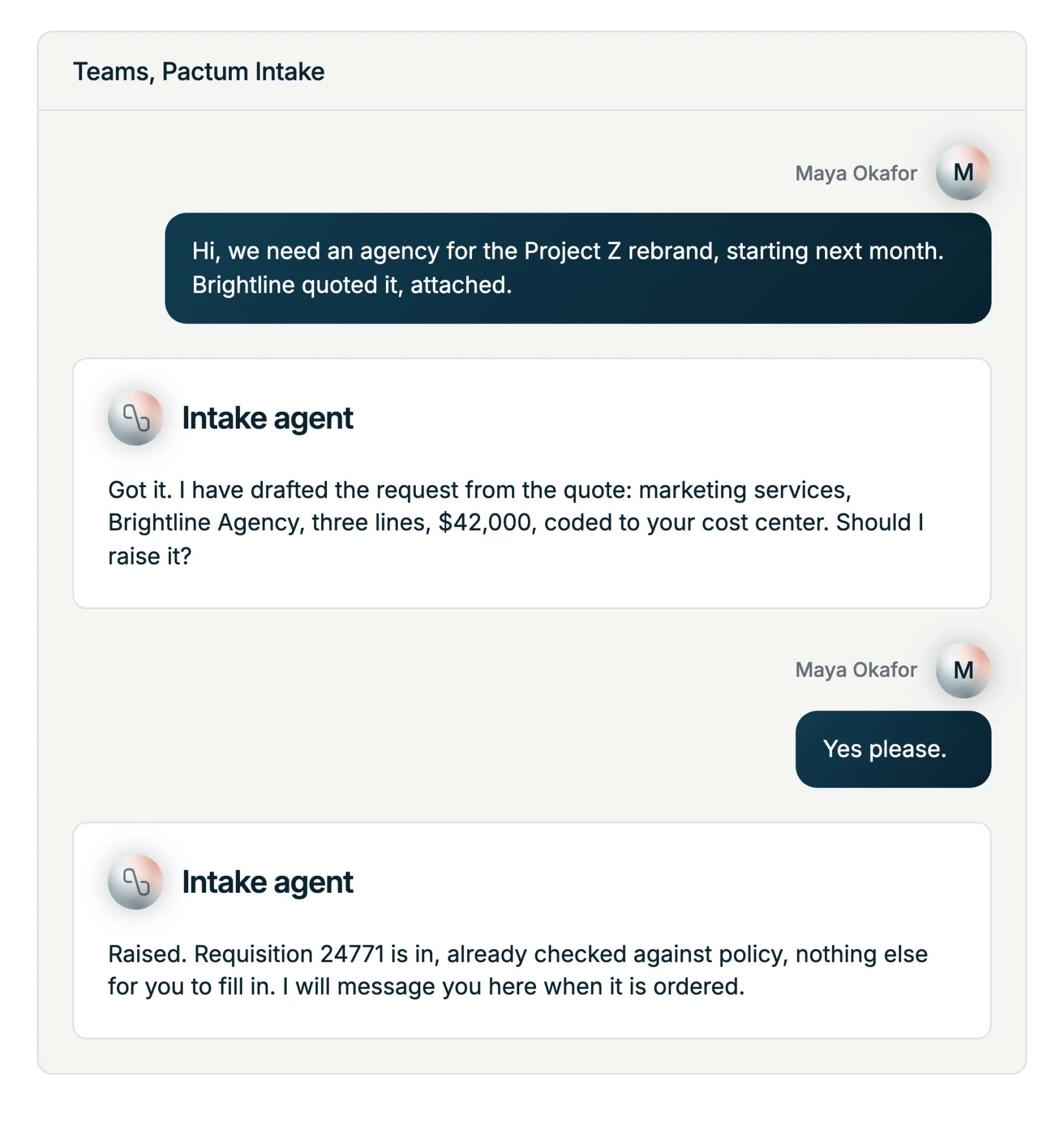
A form collects the request and hands over the work. Pactum’s Intake Agent helps take it all the way to a completed purchase, while procurement retains control of the rules.
Intake form vs. intake agent: a side-by-side comparison for procurement
| Option 1: Intake form | Option 2: Pactum’s Intake Agent | |
|---|---|---|
| What it does | Collects the request | Understands the request and takes it all the way to PO |
| Intake experience | 20 fields in a portal | One conversation in Microsoft Teams, Coupa or SAP Ariba |
| Requisition data and coding | The requester guesses the category, GL code and cost centre | Coded from your own data and matched to the right supplier record |
| Contracts and catalogues | The requester has to know they exist | Checked first, before anything new is bought |
| Requisition validation | After submission, often only above a threshold | Every request, against every policy, before it reaches a buyer |
| When validation fails | Sent back to a queue | Fixed with the requester in the same conversation |
| Approvals and routing | Every request waits for a reviewer | Clean requests go straight through, and exceptions go to a buyer |
| Sourcing and negotiation | A buyer, when they have time | Pactum’s AI agents |
| Price | The supplier’s quote | Negotiated before the PO |
| Time to PO | Days | Under a day |
| Audit trail | Depends on who reviewed it | Every check and decision logged in your P2P system |
| ERP and P2P integration | Lives inside the P2P suite | Self-service integration with Coupa and SAP Ariba, and your P2P system stays the system of record |
| Lifecycle coverage | Intake only | Intake to PO |
How Pactum’s Intake Agent takes a purchase request from intake to PO
Think about everything that normally happens between “I need this” and a purchase order. The form, the coding, the review queue, the back-and-forth, the quotes, the approvals. Days of work, spread across half a dozen people.
With Pactum, all of that runs in the background. The conversation is the first step in what we call Autonomous Procurement. Every request moves from intake to purchase order autonomously, and people only step in on exceptions.
Free eBookWhat is Autonomous Procurement?How AI agents run the buying process end to end, within the strategy and guardrails procurement sets.Download the eBook
Here’s what happens after someone says what they need:
-
Intake: the request, in their own words - The Intake Agent asks a couple of follow-up questions, reads any quote they attach, and works out the category, GL code, cost centre and supplier from your own data. Nobody fills in a form, and nobody has to know what a GL code is.
-
Contracts and catalogues first - Before anything new is bought, the agent checks what you already have. If there’s a catalogue item or an existing contract that covers the request, it steers the requester straight to it, so you get the price you’ve already negotiated.
-
Alignment: every rule, every request - The Alignment Agent checks the requisition against your policies, category rules, approved suppliers and contracts, whatever its value. If something’s wrong, it goes straight back to the requester in the same conversation and gets it fixed, usually in minutes. No queue, no email chain.
-
The right buying route, decided for you - Pactum’s AI agents work out the best way to buy it. Where there’s one realistic supplier, they negotiate with that supplier. Where several can do the job, they run a competition. And for complex, high-value buys, they support your buyers with the requirements, supplier list and negotiation strategy, while the buyer makes the call.
-
Purchase order: raised and recorded - The PO is raised in your P2P system, with every check, decision and negotiation logged in a full audit trail, right where finance and audit expect to find it.
Procurement sets the rules and the guardrails, and Pactum’s AI agents handle every step in between. Clean requests go straight through, and only the genuine exceptions land on a buyer’s desk.
What changes when you swap the form for an agent
Imagine what your buyers could achieve if they spent less time fixing requisitions and chasing missing information.
With Pactum, AI agents handle the work that slows procurement down: understanding requests, checking policies, finding the right suppliers and negotiating better terms. They take each request from conversation to purchase order (PO), with your team stepping in when human judgement matters.
Here’s what changes when Pactum’s AI agents take every request from conversation to PO.
1. Catch issues before they ever reach procurement
With a traditional form, errors often surface only after submission. A wrong code, a missing contract or an unapproved supplier can send a request back for correction, adding delays and more work.
Pactum’s Alignment Agent checks 100% of requests, regardless of value or spend threshold, against your policies, category rules, approved suppliers and contracts. When something’s wrong, it works with the requester to fix it in the same conversation, often within minutes.
Instead of discovering problems days later, your team can resolve them upfront, reducing rework and helping keep purchases compliant and moving.
More than one million requisition checks completed
2. Find savings in purchases nobody had time to negotiate
Some of the biggest missed savings hide in everyday purchases. Up to 70% of requests that teams don’t get around to negotiating may hold savings opportunities, yet these purchases often go straight to PO at the supplier’s quoted price, simply because nobody has time to negotiate.
Pactum’s AI agents check existing catalogues and contracts first, so you benefit from prices you’ve already negotiated. Where there’s room to save more, they negotiate directly with suppliers or run a competition before the PO is raised.
And what happens when someone finally has time to negotiate? Pactum customers have seen 45% of negotiated requisitions deliver savings, with 4–8% saved on that spend. Now imagine capturing those savings across all the everyday purchases your team currently doesn’t have time to negotiate.
 Customer story · Honeywell$65K saved in one negotiation: $65,000 saved in a single autonomous negotiation, with zero buyer involvementHoneywell has run 2,500+ autonomous negotiations across nearly $500M in spend.See how Honeywell did it
3. Go from request to PO in under a day
When someone needs a laptop or a software renewal, they shouldn’t have to wait days for the request to make its way through procurement.
Yet review queues of 2 to 3 days are common, and some requests sit for up to 5. By the time a buyer reviews the request, checks the details and sends it back for missing information, even a straightforward purchase can lose days.
With Pactum, requisitions can be cleared in just 90 seconds. Requests with everything in place can move straight through, while issues are flagged early instead of holding up the process. Less waiting, fewer back-and-forths, and a faster path from request to PO.
4. Give your buyers their time back, in the systems you already use
Your buyers know how to find savings, negotiate better deals and build strong supplier relationships. But too much of their day can get swallowed up by fixing codes, chasing missing details and reviewing routine requests. As purchasing volumes grow, that leaves you facing an expensive choice: hire more people to handle the workload or outsource it.
Pactum offers another way. Its AI agents handle the routine checks, reducing manual review by 99%, so buyers can focus on the requests that genuinely need their expertise and judgement.
And you don’t need to replace the systems your team already relies on. Pactum connects with Coupa and SAP Ariba through a self-service integration, while your existing P2P system remains the system of record.
Instead of adding more people to manage the workload, give your existing team more time to do what they do best.
 Customer story · SUEZ90% shorter requisition cycle time: Requisitions that used to take days now take just 90 secondsSUEZ has cut requisition cycle time by 90% and manual reviews by 80%.See how SUEZ did it
How does Pactum support the full procurement lifecycle?
Pactum’s Intake Agent is the front door to procurement, turning an employee’s request into the starting point for an end-to-end buying process. From there, Pactum’s AI agents work together to check compliance, identify the right sourcing route, negotiate with suppliers and move purchases through to a purchase order (PO).
The process runs autonomously within the strategy and guardrails your procurement team sets, with people stepping in when their expertise and judgement are needed.
Indirect procurement, run autonomously
Pactum’s AI agents for Indirect Procurement cover every step from request to PO, around the clock, so your everyday spend gets the same attention as your biggest purchases:
-
Capture the request - The Intake Agent turns a plain-language request into a complete, correctly coded requisition inside your P2P system.
-
Check every requisition - The Alignment Agent reviews every request against your policies, category rules and approved suppliers, and fixes common issues with the requester, so every requisition arrives complete and compliant.
-
Negotiate with a single supplier - Where there’s one realistic supplier, Single-Source Negotiation secures better prices and payment terms before the PO is raised.
-
Run a competition - Where several suppliers can meet the need, Tactical Sourcing puts the requirement out to competition and drives the price down.
-
Support complex, high-value buys - For bigger, more complex purchases, Advanced Sourcing prepares the requirements, supplier list and negotiation strategy, with your buyer leading the decision.
-
Capture value after sourcing - Once an RFQ or e-auction closes, Post-Sourcing Negotiation goes back to qualifying bidders to secure a better final price.
Every step is recorded in your P2P system, and the PO lands exactly where finance expects to find it.
Supplier engagement and campaigns, at scale
The same AI agents can also take on the high-volume supplier work that no team has time to do one supplier at a time:
-
Engage thousands of suppliers at once - Supplier campaigns reach your whole supplier base with personalised outreach, all at the same time.
-
Optimise payment terms - Autonomous negotiations outperform email campaigns for payment terms, bringing terms in line across your supplier portfolio.
-
Collect and validate supplier information - Supplier engagement gathers certifications, compliance documents and data at scale, so your team only handles the exceptions.
Procurement sets the strategy. Pactum’s AI agents do the work, from the first request to the last supplier conversation.
Ready to retire the form?
Give employees a simpler way to get what they need
Pactum's AI agents do the procurement work behind the scenes. See how a single conversation becomes a compliant, negotiated purchase order, autonomously.
Frequently Asked Questions
How do we validate purchase requisitions before they reach procurement?
Validate them at the point of request, while the requester is still in the conversation. With a form, checks only start after submission, so mistakes surface days later. Pactum’s Intake Agent works out the category, codes and supplier from your own data, and the Alignment Agent checks every request against your policies, contracts and approved suppliers before it reaches a buyer. If something’s wrong, the agent fixes it with the requester there and then. Read more in What If Every Purchase Requisition Arrived Complete and Compliant?
What’s the difference between an intake form and an intake agent?
An intake form collects a request, and an intake agent understands it and follows it through. A form asks the requester to fill in fields and pick categories, then passes the work to procurement. Pactum’s Intake Agent replaces the form with a conversation, builds a clean requisition, and together with Pactum’s other AI agents takes it all the way to a negotiated PO.
Can an intake agent take a request all the way to a purchase order?
Yes, with Pactum. The Intake Agent captures the request, and Pactum’s AI agents check it against your policies, choose the right buying route, negotiate or run a competition, and raise the PO in your P2P system. Clean requests reach PO in under a day, and your buyers only step in on exceptions.
Why do requisitions keep getting rejected after initial approval?
Usually because the checks happen too late. When a request is approved on the basics, problems like a wrong GL code, a missing contract link or an unapproved supplier only show up further down the line. Checking every request against the full rulebook upfront stops those rejections before they start. See what we learned from more than one million requisition checks.
Our intake process is manual and slowing down procurement. What’s the fix?
Take the form and the review queue out of the equation. Let employees describe what they need in plain language, check every request upfront, and let AI agents handle the routine sourcing and negotiation. With Pactum, requisition cycle time drops by 90%, and clean requests reach PO in under a day. Find out why your best procurement people are clearing queues, and how to change that.
Does it work with Coupa and SAP Ariba?
Yes. Pactum connects to Coupa and SAP Ariba through a self-service integration, and employees can also make requests in Microsoft Teams. Your P2P system stays the system of record, so every request and decision is recorded where finance expects to find it. See all integrations.
How do we know the AI agents make the right call?
You watch them work before you hand anything over. Pactum’s AI agents run alongside your own reviewers first, so you can see them make the same calls your team would, reaching 99% agreement at policy level before they act alone. You decide how fast each rule and category moves to full autonomy.
Does it replace procurement teams?
No. Procurement sets the rules, the guardrails and the strategy, and Pactum’s AI agents do the routine work at scale. Your buyers spend less time on reviews and more time on the sourcing, supplier relationships and decisions that need human judgement. Read how a procurement centre of excellence can scale without adding headcount.