By Pactum · · 20 min read
TL;DR
If you only have 30 seconds, here’s what a bad requisition is really costing you.
-
Fixing one bad requisition takes minutes. Fixing thousands takes your team’s entire week. A wrong code, a missing quote, the wrong supplier, each one quick to fix on its own.
-
You’re paying more than you should. Requests go straight to PO at the supplier’s quoted price, often missing deals you’ve already negotiated and savings nobody had time to chase.
-
Spend happens without procurement. When requests stall, people pick their own supplier, put it on a card, or buy first and raise the requisition later, and indirect spend slips out of view.
-
Compliance gaps stay hidden. Requests under a threshold, or waved through by stretched reviewers, never get a proper policy check.
-
Your buyers get stuck in a rework loop. Fix it, send it back, resubmit, approve again, and sometimes reject it after sourcing has already started. That’s how your best people end up clearing queues.
-
Pactum’s new Intake Agent gets it right at the source. Every request is checked, fixed, and taken all the way to a negotiated PO, autonomously, in under a day.
-
Your buyers get to be buyers again. Your team keeps pace with the business without adding headcount.
Why bad requisitions cost procurement so much
Someone needs a new laptop and picks the closest category on the form. A team lead submits a renewal without attaching a quote. Another employee raises a service as goods because that’s the option that makes sense to them.
None of these mistakes looks like a big deal. After all, a buyer can easily fix each one.
But multiply those minutes across thousands of requisitions, and you’re looking at hours of rework, delayed purchases, and missed savings.
Let’s be honest, nobody puts “fix requisitions” in a procurement strategy. Yet it’s where a huge amount of your team’s time goes.
And procurement isn’t the only team paying for it. Employees wait for the equipment and software they need. Finance loses visibility into where money is going. And when an auditor asks why a purchase went through, the evidence might not be there, unless every requisition gets checked.
The cost of all this adds up faster than you might think. APQC research puts the cost of processing a single purchase order at roughly $14 to more than $54, depending on the organisation. For a team raising 50,000 POs a year, that’s the difference between roughly $700,000 and $2.7 million.
So what does a bad requisition really cost? It’s a lot more than a few minutes of rework.
The 5 hidden costs of a bad requisition
1. Paying more than you should on everyday purchases
Most everyday requests go straight to PO at whatever the supplier quoted. Nobody checks whether the price is right, because nobody has the time to negotiate every purchase.
Free-text requests make it worse. When a requester doesn’t know a contract exists, they skip the catalogue and ask whoever they know for a quote, so the prices you’ve already negotiated never get used. Contracts quietly expire too, and spend keeps flowing to suppliers on terms nobody has looked at in years.
Buyers we’ve spoken to have found renewals where the price had crept up 20%, and nobody noticed until long after the PO went out. Your team cares about price. There are simply too many requests to challenge every one, so the smaller purchases never get a second look, or a competitive quote.
And it keeps adding up. Up to 70% of the requests teams never get around to negotiating turn out to hold savings, and suppliers are often happy to negotiate. That’s real money left on the table, and your finance team isn’t going to be very happy about that.
2. Maverick spend that procurement never gets a say in
When the official process feels slow, people find workarounds. They choose their own supplier, pay by card, or buy first and raise the requisition afterwards.
One procurement manager told us that most of what lands in their review queue has already been bought. Why does this keep happening?
Because the workaround is faster than the process. When a review takes days instead of seconds, people don’t wait. Many systems don’t flag after-the-fact requisitions, and plenty don’t require a contract at all, so nothing checks it against policy and nothing stops it.
The consequences add up quickly. Preferred-supplier agreements go unused, supplier risks get missed, and category strategies have little influence over spending they can’t see. One team told us their category managers only see 20 to 30% of requisitions. Everything else happens without them.
3. Compliance gaps nobody sees until audit
Nobody can review every request by hand, so teams draw a line. At one procurement team, requests under $3,000 skipped review altogether. Above the line, stretched reviewers wave ambiguous cases through just to keep the queue moving, and approvals turn into rubber stamps.
Then there’s the data. Requesters pick the first code that works, or a generic one, because nobody codes it for them. Descriptions arrive as “services” or simply “hvac”. One procurement director told us their biggest spend category was “undefined”.
Individually, these shortcuts may seem harmless. Collectively, they leave off-policy spend undetected, supplier records out of date, and spend reports that don’t reflect what the business actually buys.
And when audit asks why a purchase went through, there’s no clear answer. That’s an audit finding nobody wants to explain.
4. Requisitions rejected after approval, and buyers stuck in a rework loop
Ask any buyer how their day starts, and you’ll hear the same things: correcting GL codes and cost centres, chasing missing quotes, and sending requests back with a note to “please add the contract”.
Here’s why it keeps happening. Requisition forms were built around procurement’s categories, policies, and codes, and the people filling them in aren’t procurement people. As one procurement team put it, coding just isn’t something you can train the whole business to do.
When a requisition gets rejected, the requester often can’t fix it themselves. It goes back and forth between teams, each time restarting the process. The rework never seems to end.
By then, several people have spent time on a request that should have been right from the start. And with procurement workloads expected to rise 8% in 2026 while headcount and budgets decline, according to Hackett Group research, there’s little room for this kind of rework.
Your buyers know exactly how to fix a requisition. They just can’t do it thousands of times a year and still have time to buy well.
5. Waiting that frustrates the business, and makes procurement the bad guy
A review service level of 2 to 3 days is common, and requests can sit for up to 5 days. If a requester is off for a bank holiday and misses a question, the request can be rejected and the clock starts again.
Meanwhile, the people waiting for a laptop or a software renewal can’t do their jobs, when an intake agent could have taken their request to PO in under a day. And every rejection lands with a buyer’s name on it, so procurement becomes the department that always says no, even though it’s only fixing problems that started at the form.
That’s exactly what pushes people back to the workarounds. The slower the process feels, the more spend goes around it.
Add it all up, and a bad requisition costs you savings, spend control, compliance, and goodwill, all before a PO is raised.
Where intake and orchestration tools stop
To be fair, intake forms and orchestration tools have made buying easier for the business. Employees get a friendlier front door, guided forms, and a clear workflow that routes each request to the right approver.
That’s a real improvement for the requester. But look at what happens once someone hits submit.
The tool captures the request and moves it along, and then it lands on someone’s desk. The work of getting it right still sits with your team:
- Your team still checks it
Someone has to test every request against policy, approved suppliers, and the right contract.
- Your team still fixes it
Wrong codes, missing quotes, and off-contract suppliers still need a buyer to correct them or send them back.
- Your team still decides how to buy it
The tool routes the request, but a buyer still works out whether it belongs on a contract, in a negotiation, or in a competition.
- Your team still negotiates it
Some tools help buyers prepare, but someone still has to contact the supplier and agree the price.
Intake and orchestration tools organise the work, and your team still does it. A bad requisition just reaches your buyers faster and in a tidier format.
So what if a bad requisition never made it to your buyers’ queue in the first place?
How Pactum’s AI agents stop a bad requisition before it costs you
How to validate purchase requisitions before they reach procurement
The best way to validate purchase requisitions before they reach procurement is to check them at the source, the moment someone asks for something, with an intake agent.
An intake agent is an AI agent that turns an employee’s plain-language request into a complete, compliant requisition, so anyone in the business can buy what they need without having to understand how procurement works.
Here’s how Pactum’s Intake Agent works:
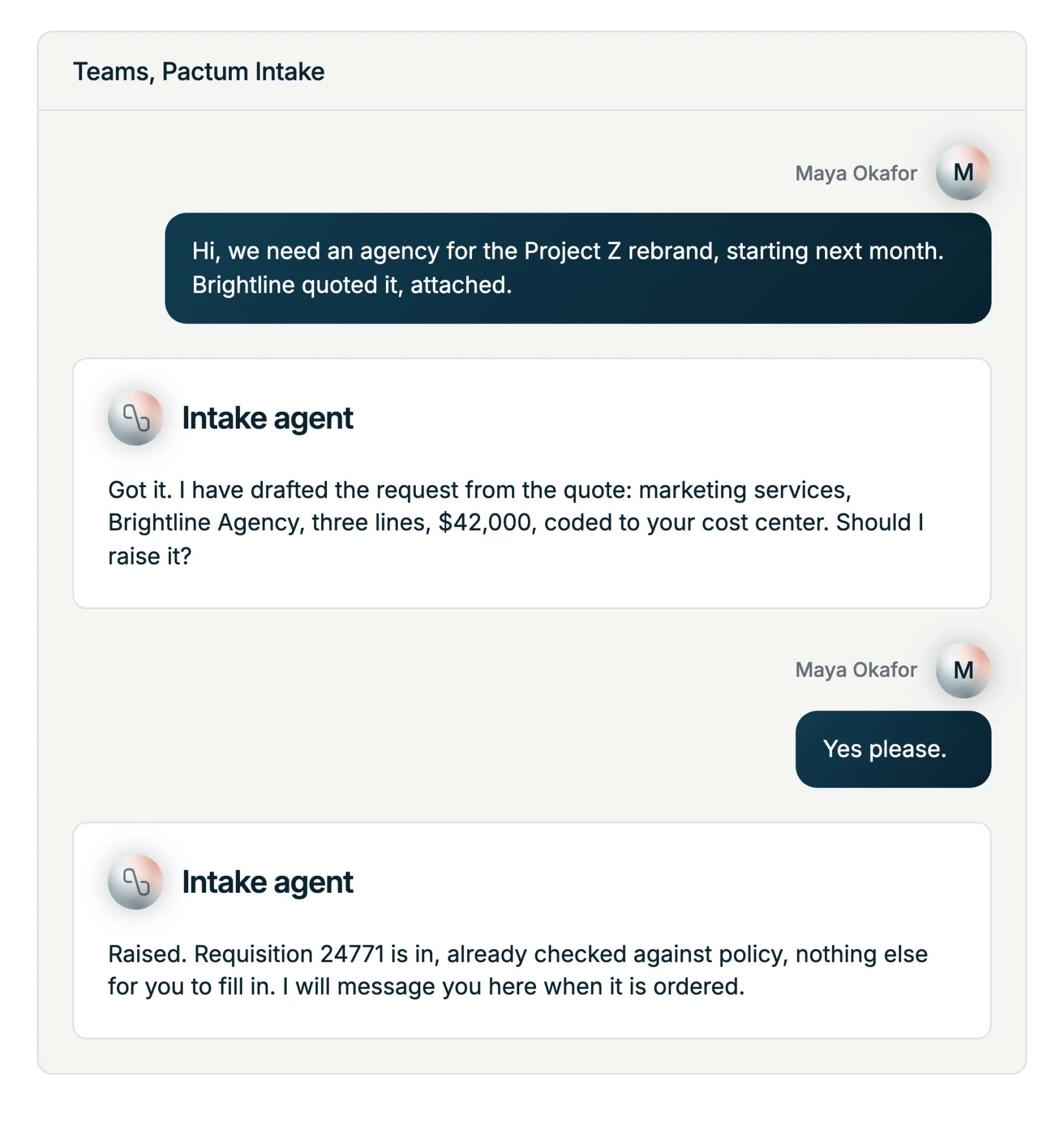
- Employees simply describe what they need, just as they would to a colleague, in Microsoft Teams, Coupa or SAP Ariba. No forms, no guessing, no back-and-forth.
- Pactum’s Intake Agent works out the spend category, GL code, cost centre, and supplier from your own data, and checks your catalogues and contracts first, so the prices you’ve already negotiated actually get used.
- The Alignment Agent then checks every request against your procurement policies, at any value, and fixes common issues on the spot, before anyone has to send it back.
- And the request keeps moving. Pactum’s AI agents choose the right buying route, negotiate with the supplier or run a competition, and raise the PO, autonomously, in under a day.
How Pactum removes each hidden cost, step by step
| Step | The problem it solves | What Pactum’s AI agents do |
|---|---|---|
| Ask | Guessed fields and free text | Employees describe what they need in plain language, and the Intake Agent captures it |
| Understand and code | Wrong codes and vague descriptions | The Intake Agent works out the category, GL code, cost centre, and supplier from your own data |
| Match to contracts | Missed contract prices and buying around procurement | Catalogues, contracts, and preferred suppliers are checked first |
| Check | Thresholds and rubber stamps | The Alignment Agent checks every request against policy, at any value |
| Fix | The rework loop | Common issues are fixed before anyone has to send it back |
| Negotiate or source | Savings lost at the quoted price | Pactum’s AI agents negotiate with the supplier or run a competition, through Single-Source Negotiation or Tactical Sourcing |
| Order and record | Days of waiting and no audit trail | The PO is raised in under a day, with every decision logged in your P2P system |
From intake to PO, fully autonomous
Most intake tools hand the request back to your team at some point. With Pactum, it just keeps going.
Here’s the simple version. Your people type in what they need. Pactum’s AI agents turn that into a requisition, check it, negotiate a better price, and raise the purchase order. Nobody on your team has to touch it, and the whole thing happens in under a day.
Let’s follow one request. Say someone in marketing needs three more licences for their design software. Click through each step, or just watch it play.
How it works
From “I need this” to a purchase order
Step 1 of 5 · You ask
Someone in your teamHi! Could I get three more licences for our design software? Two new people are starting on Monday.
No forms, no codes, and no guessing which category it belongs in. Your people ask in Microsoft Teams, Coupa or SAP Ariba, in their own words.
- No forms
- Plain language
- Works where you already are
Step 2 of 5 · AI agents build the requisition
The Intake Agent asks a quick follow-up if it needs to, then fills in the category, GL code, cost centre and supplier from your own data. It checks your contracts and catalogues first, so the prices you've already agreed actually get used.
- Category
- GL code
- Cost centre
- Supplier
- Existing contract found
Step 3 of 5 · AI agents check it
The Alignment Agent checks the request against your policies, approved suppliers and budget. If something's off, it fixes it on the spot, or sorts it out with the requester there and then. Nothing sits in a queue waiting to be sent back.
- Policy
- Approved supplier
- Budget
- Fixed on the spot
Step 4 of 5 · AI agents negotiate
Pactum's AI agents negotiate with the supplier, or run a quick competition between several, to improve the price and terms. Suppliers are happy to take part, and the deal is locked in before the PO.
- Better price
- Better terms
- Deal agreed
Step 5 of 5 · Purchase order
The PO is raised in Coupa or SAP Ariba, with every check and decision logged for audit. Two new starters get their software on day one, and nobody on your team had to lift a finger.
- PO raised
- Audit trail logged
- Under a day
Procurement sets the rules. Pactum's AI agents handle every step in between.
And when a request doesn’t fit the rules? It goes to a buyer as an exception, with the details they need already attached, so they can make the call quickly.
This is what we call Autonomous Procurement. The whole buying process runs itself, and people only step in on exceptions. Procurement sets the rules and the strategy, and Pactum’s AI agents handle every step in between.
Free eBookWhat is Autonomous Procurement?How AI agents run the buying process end to end, within the strategy and guardrails procurement sets.Download the eBook
What changes when bad requisitions stop reaching your buyers
Imagine every request arriving complete, coded correctly, checked against policy, and priced as well as it could be, without anyone on your team having to touch it.
Get requisitions right the first time, and give your buyers the freedom to drive savings, strike better deals, and create real business value.
1. Stop overpaying on everyday purchases
Remember those everyday purchases that went straight to PO at the quoted price? With Pactum, your contract and catalogue prices are applied first, so the deals you’ve already negotiated actually get used.
Then Pactum’s AI agents look for more. Wherever there’s an opportunity, they negotiate with the supplier or run a competition between several, on requests your team would never have had time to touch. And because every request gets checked, a renewal that has quietly crept up 20% gets caught before the PO goes out, not months later.
Suppliers are on board too. Many actually prefer negotiating with AI, because it’s quick, consistent, and available whenever they are.
Across customers, negotiated requisitions and tactical sourcing events have delivered 1 to 15% savings on spend that used to go straight to PO. Now imagine what that adds up to across thousands of everyday purchases. Your finance team will be very happy about that.
 Customer story · Honeywell$65K saved in one negotiation: $65,000 saved in a single negotiation, with no human involvedHoneywell has run 2,500+ autonomous negotiations across nearly $500M in spend.See how Honeywell did it
2. Maverick spend back under procurement control
Imagine your procurement strategy reaching every purchase, instead of the 20 to 30% your team used to see. Your contracts get used, and maverick spend stops being normal.
The Intake Agent checks your catalogues and contracts first, and the Alignment Agent steers anything off-contract back to your preferred suppliers before it becomes a PO.
And when the official route is also the fastest one, people stop buying around it. Procurement sets the strategy once, and Pactum’s AI agents apply it to every request, without anyone having to police it.
3. Requisition compliance with no thresholds and no blind spots
No more thresholds, and no more sampling. That $3,000 request that used to skip review gets the same check as a $300,000 one.
Pactum checks 100% of requests against your policies, category rules, approved suppliers, and data standards, and codes them correctly from your own data. Every check follows the rules your team has set, so ambiguous cases get flagged before they turn into rubber stamps.
Your spend data gets better too. Requests arrive with the right category and a clear description, so “hvac” and “undefined” stop showing up in your spend reports, and you can finally see what the business is really buying.
Every check and outcome is logged in your P2P system. So when audit asks why a purchase went through, the answer is right there, and that’s one audit finding you won’t have to explain.
 Milestone1M+ requisitions checked: More than one million requisition checks completedEvery request is checked against policy, approved suppliers, contracts and pricing in just 90 seconds, with a full audit trail behind each decision.See what it means for procurement
4. More time for the work only your buyers can do
Remember the GL codes, the missing quotes, and the requests bouncing back and forth? With Pactum, issues get fixed before anyone has to send a request back, so the rework loop simply disappears. Requesters don’t get stuck with a rejection they can’t fix, and buyers don’t have to chase them.
Your buyers only step in on the exceptions that really need their judgement, and those arrive with the details already in place.
That means more time for sourcing, supplier relationships, and the decisions where they make the biggest difference. And with workloads rising while headcount isn’t, it gives you a team that keeps pace with the business without adding headcount.
Just imagine what your team could do with all that time back.
 Customer story · SUEZ80% less manual review time: At SUEZ, Pactum eliminated 80% of manual review timeSUEZ has also cut requisition cycle time by 90%.See how SUEZ did it
5. Go from “I need this” to PO in under a day
Remember the requests sitting in a queue for 2 to 3 days, or getting rejected because someone was off for a bank holiday? With Pactum, review starts the moment a request is raised, and nothing waits for someone to get through their queue.
Every requisition gets reviewed in just 90 seconds. That’s faster than most people can fill in the form.
So employees get their laptop or software renewal sooner, and the official route becomes the fastest one. That’s when people stop looking for workarounds, and procurement stops being the department that always says no.
And all of this works inside Coupa and SAP Ariba and Microsoft Teams. Your P2P system stays the system of record, so there’s nothing to rip out and nothing to rebuild.
Stop bad requisitions before they cost you
Get every request right at the source
Every bad requisition you stop at the source is savings, control, and time you get back. Let's show you what that looks like on your own requests.
Frequently Asked Questions
What is a bad requisition?
A bad requisition is any purchase request that arrives incomplete, miscoded, off-contract or against policy, so someone has to fix it, chase it, or send it back before it can become a PO. Common examples are a wrong GL code, a missing quote, or a free-text request for a supplier you have no contract with.
What does a bad requisition cost a procurement team?
Far more than the few minutes it takes to fix. A bad requisition costs you savings when prices go unnegotiated, spend control when people buy around procurement, and compliance when requests skip review. It also costs your buyers hours of rework and leaves employees waiting days for what they need. Pactum’s AI agents stop those costs at the source.
How do we validate purchase requisitions before they reach procurement?
Check them at the source, before they ever reach a buyer’s queue. Pactum’s Intake Agent turns a plain-language request into a complete, correctly coded requisition, and the Alignment Agent checks every request against your policies, at any value. Common issues are fixed on the spot, so buyers only see the exceptions. Our guide to intake agents explains how it works, and here’s what it looks like when every requisition arrives complete and compliant.
What are the best AI tools for requisition intake and validation at scale?
Look for a tool that does more than capture and route the request. Pactum’s Intake Agent turns a plain-language request into a complete requisition, the Alignment Agent checks every one against your policies, and Pactum’s AI agents negotiate and raise the PO, autonomously, in under a day. It works inside Coupa and SAP Ariba, and here’s how an intake agent compares with an intake form.
We can’t align requisitions with procurement strategy at scale, how?
Set the rules once, and let AI agents apply them to every request. Procurement defines the policies, preferred suppliers, and buying routes, and Pactum’s AI agents check every requisition against them and steer it toward the right contract. At SUEZ, that freed 10% of buyer time for strategic sourcing.
Why do requisitions get rejected after spending weeks in sourcing?
Because the checks happen too late. When each approver only looks at one thing, issues like a missing contract, the wrong category, or an off-policy supplier surface after several people have already worked on the request. Checking every requisition at intake, before sourcing starts, stops that wasted work.
Why do requisitions keep getting rejected after initial approval?
Usually because the first approval only checked part of the request. Budget owners approve the spend, and procurement checks policy, codes, and contracts later, so problems get caught one step at a time. Pactum’s AI agents check the whole requisition up front and fix common issues before it moves on.
Does requisition alignment improve procurement compliance rates?
Yes, because every request gets checked, whatever its value. Pactum checks 100% of requisitions against your policies, approved suppliers, and data standards, and logs every decision for audit. Pactum has now completed more than one million requisition checks.
Does it replace procurement teams?
No. Procurement sets the rules and the strategy, and Pactum’s AI agents handle the reviewing, correcting, routing, and routine negotiation. Your buyers step in on exceptions and spend their time on the strategic work that needs them. Here’s how enterprise procurement leaders use AI today.