By Pactum · · 10 min read
TL;DR
If you only have 30 seconds, here’s a recap:
-
Requisition review is one of the most time-consuming processes in enterprise procurement. Hours of every working day disappear into a queue of purchase requests, and the volume keeps growing while the teams responsible for it stay exactly the same size.
-
When volume wins, quality is what pays the price. Checks get rationed, compliance drifts across teams and regions, and off-policy spend moves forward before anyone catches it.
-
Pactum’s Requisition Alignment agent reviews, analyzes, and corrects every requisition against the same standard that used to take hours, clearing a two-day manual process in a matter of seconds.
-
Cycle times drop. Pactum cuts manual review effort by 99%, reduces rework by 80%, and redirects more than 20% of buyer capacity toward strategic work.
-
Pactum’s agents run across the entire procurement lifecycle, from intake to negotiation to signature, built into the P2P systems your teams already use.
The work that never stops
Procurement operations teams are under more pressure than ever to deliver, and yet hours of every working day disappear into a queue of purchase requests, with someone checking whether each one clears before anything can move forward.
It is mundane, it is repetitive, and it never stops. As supplier bases widen, compliance demands deepen, and finance tightens its grip on every transaction, the volume grows heavier while the teams responsible for it stay exactly the same size.
The organizations getting ahead of this have stopped trying to hire their way out of it and started deploying AI agents instead.
The hidden work behind every requisition
Behind every purchase order is a process most of the business has never seen. Before anything can move forward, someone has to work through a checklist that runs far deeper than it looks:
-
Supplier setup - Supplier credentials, system setup, tax details, payment terms, and banking information all verified before the relationship can go live.
-
Commercial alignment - Category and budget codes confirmed, contract linkage established, and preferred supplier arrangements checked against what procurement agreed.
-
Authority and competition - Delegation of authority thresholds reviewed and competing bid requirements assessed.
-
Risk and terms - Statement of work validated, sanctions exposure screened, and commercial terms aligned to what procurement originally negotiated.
And that is before the company-specific layer even kicks in, with regional policies, category rules, approval flows that shift depending on the combination of supplier, value, and spend band, and escalation logic that has been updated more times than anyone can track.
What breaks when volume wins
Most enterprises set a 48-hour turnaround target for requisition review, and against the reality of hundreds of requests arriving every week, each carrying dozens of checks across disconnected systems, that target becomes a sprint with no finish line. When the volume wins, quality is what pays the price:
-
Checks get rationed - High-risk checks get attention while lower-risk ones receive a quick scan, because there is only so much time in the day.
-
Rework loops pile up - Wherever submissions arrive incomplete, they bounce back and forth, consuming time and delaying higher-value procurement work.
-
Compliance drifts - Policy is applied unevenly across teams and geographies, and gaps open quietly in the background.
-
Off-policy spend slips through - Spend moves forward before it is caught, and by the time issues surface, the options for fixing them have narrowed considerably.
What begins as a backlog problem escalates into a commercial and audit risk, and those delays at intake slow down operations, supplier engagement, and the wider supply chain.
Procurement teams already know exactly how to review a requisition properly. The only thing standing in the way is the time to apply that same standard to every single request, consistently, no matter how long the queue gets.
Meet the agent running your requisition process
The checks your procurement team has been running by hand are now handled by Pactum’s Requisition Alignment agent. Every purchase requisition that enters the workflow is reviewed, analyzed, and corrected against the same standard that used to take hours to apply manually:
-
Supplier readiness - Supplier credentials, onboarding status, and system setup.
-
Commercial terms - Pricing structures, rate cards, and contracted commercial terms.
-
Contract linkage - Preferred supplier arrangements and contract linkage.
-
Policy and rules - Organizational policies, regional rules, and category-specific requirements.
Reviewing one requisition this way saves an afternoon. Reviewing every requisition this way transforms how procurement operates.
See Pactum AI agents in action
From a two-day queue to seconds
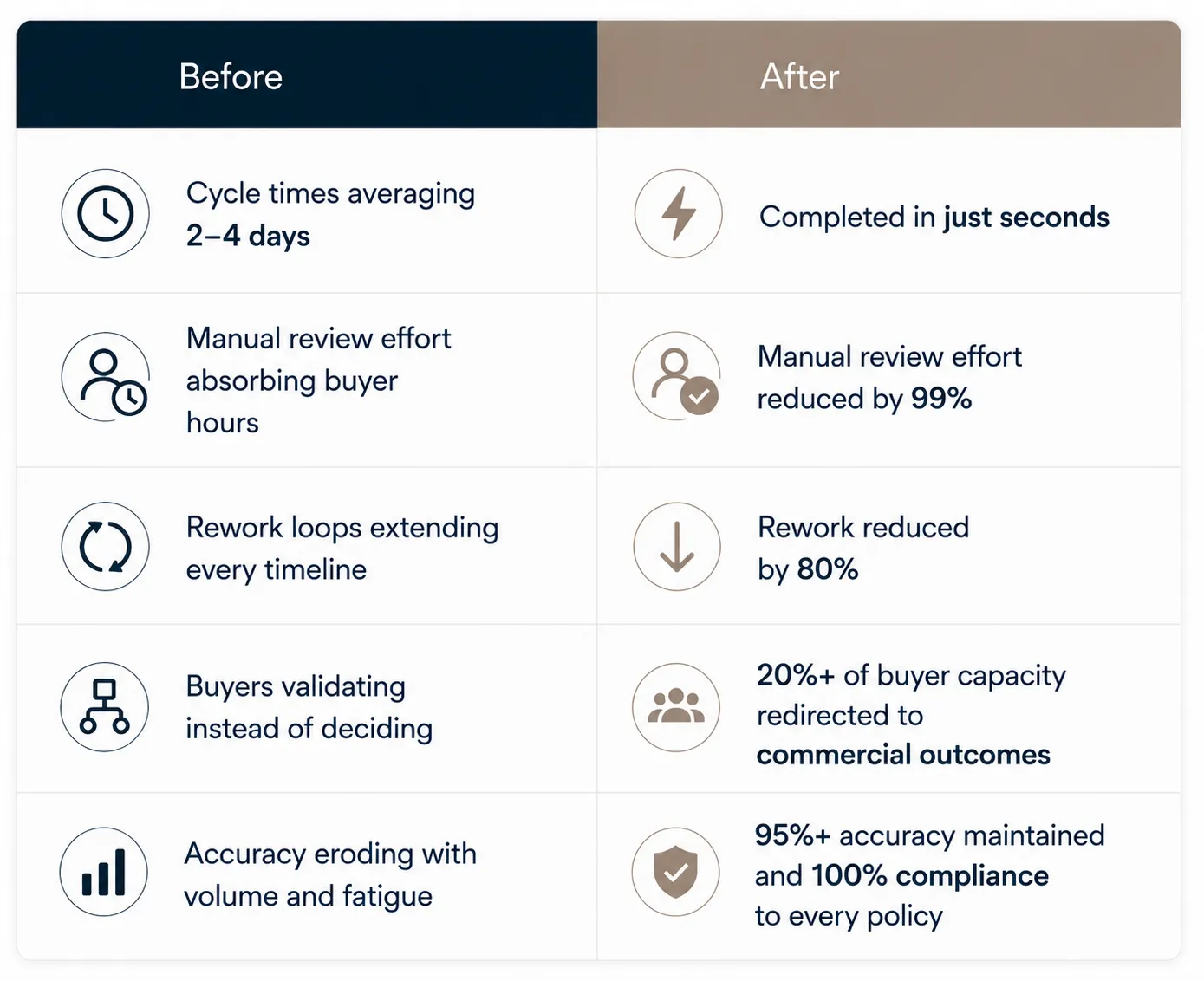
A requisition submitted at 4:55pm on a Friday no longer sits in a queue until Tuesday morning, it clears before the business closes for the weekend. Pactum reduces a two-day manual review and rework process to a matter of seconds, and it automatically fixes and corrects inaccurate requisitions along the way.
Across hundreds of thousands of requisitions every year, the hours that once disappeared into the queue become available for the work that actually moves the business forward.
The bar that manual review could never hold
In a manual process, consistency tends to erode with volume, as teams develop their own patterns, regions apply policies differently, and the standard of review shifts depending on how much time is left in the day.
Agentic AI does not drift, and it applies the same level of care to the 10,000th request as it does to the first, across every team, region, and category, regardless of how long the queue is, how layered the policies are, or how many other priorities are pressing on the business.
The audit trail that builds itself
The further a problem travels, the more expensive it becomes, and off-policy purchases, missed supplier agreements, and compliance gaps rarely stay small, compounding over time into pricing leakage, commercial risk, and costly remediation.
Pactum AI agents catch gaps and inconsistencies at the point of entry, before they ever move downstream, and every check, flag, and outcome is fully traceable, giving procurement teams complete visibility and an audit trail that builds itself.
Give your team weeks back
Every hour a procurement professional spends on manual validation and fixing is an hour the business does not get back in commercial outcomes. Pactum AI agents give teams those hours back, cutting manual review effort by 99%, reducing rework by 80%, and redirecting more than 20% of buyer capacity toward strategic work.
How to bring agents into your P2P workflow
Most technology asks for trust upfront. Pactum earns it first, step by step, running alongside your existing process on real requisitions and showing you exactly what it finds:
-
Observer mode - The agent runs quietly alongside your existing P2P process, checking every live requisition in the background without influencing a single approval, so teams can compare its outputs against their own reviews before anything changes.
-
Advisor mode - Once trust is built, its findings feed directly into live approval decisions, with human oversight still firmly at the center of every outcome, and transparent feedback helps requesters understand why submissions fail, improving requisition quality and building a stronger culture of compliance over time.
-
Autonomous mode - The agent handles routine review work independently while procurement teams move toward the exceptions, escalations, and judgment calls that genuinely need a human in the room, and it can automatically remediate certain policy violations, correcting issues such as categories, units of measure, prices, and quantities.
Connected directly to Coupa, Pactum operates inside your existing workflows from day one, with no new systems, no parallel processes, and no disruption to the way your teams already work.
The new operating model for procurement
Fixing requisitions is where the work starts. From there, Pactum’s agents run across the entire procurement lifecycle, executing the commercial work that previously sat beyond the reach of any team, regardless of its size or ambition:
-
Requisition Alignment agents check every purchase request for policy and contract compliance before it becomes a purchase order, closing the gap between what procurement intends and what actually moves forward.
-
Tactical Sourcing Negotiations agents turn single-supplier requests into competitive events and negotiate with every bidder, securing the best available terms across every category.
-
Negotiation agents contact every supplier, negotiate autonomously, and close agreements in each supplier’s own language, at a scale no team could replicate manually.
-
Contract Alignment agents check every contract for compliance and quality, pushing completed deals through to signature with every commercial condition intact
-
Campaign agents renegotiate payment terms, rebates, and prices across thousands of suppliers simultaneously.
The organizations redefining what procurement delivers have made one shift: their best people are no longer clearing queues. Requests arrive complete, policy holds without exception, and buyers spend their time on the decisions that genuinely need them.
Procurement teams set the strategy, and Pactum’s agents do the work, compliant by design, always saving, and built into the systems your teams already use.
See how Pactum clears your requisition queue in seconds
The queue was never procurement’s job, and now it belongs to the agents.
Frequently Asked Questions
Can AI really handle purchase requisition reviews?
Yes. AI agents can run every check a buyer would run, comparing each requisition against supplier credentials, contracted terms, preferred supplier arrangements, and organizational policy, then correcting what is wrong before the request moves forward. This reduces a process that used to take hours down to seconds, while human oversight stays firmly at the center of every outcome.
What is the biggest benefit of automating requisition reviews?
Speed and consistency at scale. Instead of rationing attention to the highest-risk requests, procurement can apply the same standard of review to every requisition, across every team, region, and category, no matter how long the queue gets or how layered the policies are.
Why Are requisition reviews so time-consuming in enterprise procurement?
Every request carries dozens of checks spread across disconnected systems, from supplier setup and tax details to contract linkage, delegation of authority thresholds, and category-specific rules. Because that work is manual and the volume keeps growing while teams stay the same size, the 48-hour turnaround target quickly becomes a sprint with no finish line.
How do procurement teams review requisitions today?
Most teams work through a checklist by hand, verifying supplier information, confirming budget and category codes, checking contract linkage, screening for risk, and aligning commercial terms to what was originally negotiated. With hundreds of requests arriving every week, there is rarely enough time to apply that standard evenly across all of them.
Does AI replace procurement professionals?
No. Pactum handles the routine review and correction work, while procurement professionals move toward the exceptions, escalations, and judgment calls that genuinely need a human in the room. The agent prepares and corrects the work, and people make the decisions that matter.
What information does Pactum use to validate a requisition?
Pactum draws on internal commercial data such as contracted prices, rate cards, supplier history, and preferred supplier arrangements, then applies your organizational policies, regional rules, and category-specific requirements to assess whether each requisition is compliant and accurate before it becomes a purchase order.
How does Pactum fit into our existing systems?
Pactum connects directly to Coupa and operates inside your existing workflows from day one, with no new systems, no parallel processes, and no disruption to the way your teams already work. It can start in observer mode, move to advisor mode, and progress to autonomous mode at the pace that builds your trust.
Are requisition reviews the only use case for AI in procurement?
No. The same intelligence that aligns requisitions also runs competitive sourcing events, negotiates with suppliers autonomously, checks contracts through to signature and renegotiates terms across thousands of suppliers at once, across the entire procurement lifecycle.