What does an AI‑native procurement team look like?
“Every request gets bought the way your best buyer would, around the clock.”
Daniel Barnes, Head of Marketing, PactumFormer procurement and contract management leader. Founder and chief editor of World of Procurement.
TL;DR
The AI-native procurement team is one idea everyone has considered, but not many have got it live. If you only have 30 seconds, here's what you need to know:
- An AI-native procurement team is one where Digital Workers do the routine work on every request, from the first ask to the saved record, around the clock. People own strategy, complex deals, and the rules the Digital Workers follow.
- Autonomous procurement has Digital Workers doing the work inside your approval flow, where procurement automation only moves a request along it. The workflow stays, and the work in each step gets done for you.
- The team has six layers: the Intake Agent, Alignment Agents, Sourcing, Negotiation, the system of record, and a procurement brain. The first four are Digital Workers doing the work, and the last two are what they stand on.
- Control is built in. Your rules decide what the Digital Workers may do, Alignment enforces them on every request, every negotiation stays inside your limits, and every result is written back with an audit report on every check.
- The procurement team moves up to the work only people can do, and new roles are forming around the Digital Workers. Some teams already have AI sourcing roles and people who own autonomous negotiation and AI.
- Start with one layer in observer mode, where it runs on real requests and records what it would have done without acting. Hand it more as it earns trust, then add the next layer.
- Measure it on time, coverage, savings, capacity, and trust. How fast each request is handled, how much of your spend gets worked on, what that work returns, how much volume it takes on, and how often its decisions match your reviewers'.
What is an AI-native procurement team?
An AI-native procurement team is built around Digital Workers that do the work on every request themselves: they take the request, check it, get quotes, negotiate, and write the result back, so every request gets bought the way your best buyer would, around the clock. People stay in charge of what needs judgment, which is category strategy, complex sourcing events, key supplier relationships, and the rules the Digital Workers follow.
Digital Workers are AI agents that each own one procurement job and do it on every request they are given, and autonomous procurement is what you get when they run that work end to end inside limits your team sets. Pactum's Digital Workers run indirect procurement from intake to purchase order, within the system of record you already use, such as Coupa, SAP Ariba or SAP S/4HANA, guided by your policies and strategy.
The difference shows on the requests nobody had time for, such as single-supplier buys, small tactical purchases, and renewals that go through as raised. An AI-native team can work each one your rules allow, from the smallest tactical buy to the complex, buyer-led deals, so the savings come from spend that used to go through untouched.
What is the difference between autonomous procurement and procurement automation?
Procurement automation moves a request along a fixed path, such as routing a form to the next approver, while autonomous procurement has Digital Workers doing the work inside that path. The workflow still exists, and the work in each step gets done for you.
Inside that path, Digital Workers read the request, check it against your rules, send it down the right buying route, get the quotes, negotiate the price, and write everything back, one after another, so a person only sees what needs their judgment. There's more on this in how AI agents do procurement work.
What are the six layers of an AI-native procurement team?
The operating model of an AI-native procurement team has six layers: the Intake Agent, Alignment Agents, Sourcing, Negotiation, the system of record, and the procurement brain. The first four are Digital Workers doing the work, and the last two are what they stand on, the record they write to and the rules they follow. See how the six layers fit together for indirect procurement.
1. Intake Agent
The Intake Agent is where every request starts, and it turns a plain conversation into a finished requisition.
- Takes requests in plain words and helps requesters figure things out, all in the chat where you work today
- Works out the category and the right way to buy from the conversation
- Finds catalog and contract items first and checks the available buying routes in seconds
- Builds the requisition in Coupa, SAP Ariba, or wherever your system of record is
See how it works on the Intake Agent page.
2. Alignment Agents
Alignment Agents work as a pair with the Intake Agent: Intake helps the requester, and Alignment helps procurement buy better and in line with its policies, checking and enforcing your buying rules on every request. It's a new idea for many teams, and it's the most important layer to get right when you hand work to AI, because every other layer depends on requests that follow your rules.
- Checks every request against your buying rules, so nothing goes astray and the right decision gets made every time
- Reads the quotes, the attachments, and anything the Intake Agent has built, then builds the right buying strategy
- Looks up live contracts and works out whether they can be used
- Brings in the right approver, or acts as the approver
- Leaves its reasons on the request and moves it forward
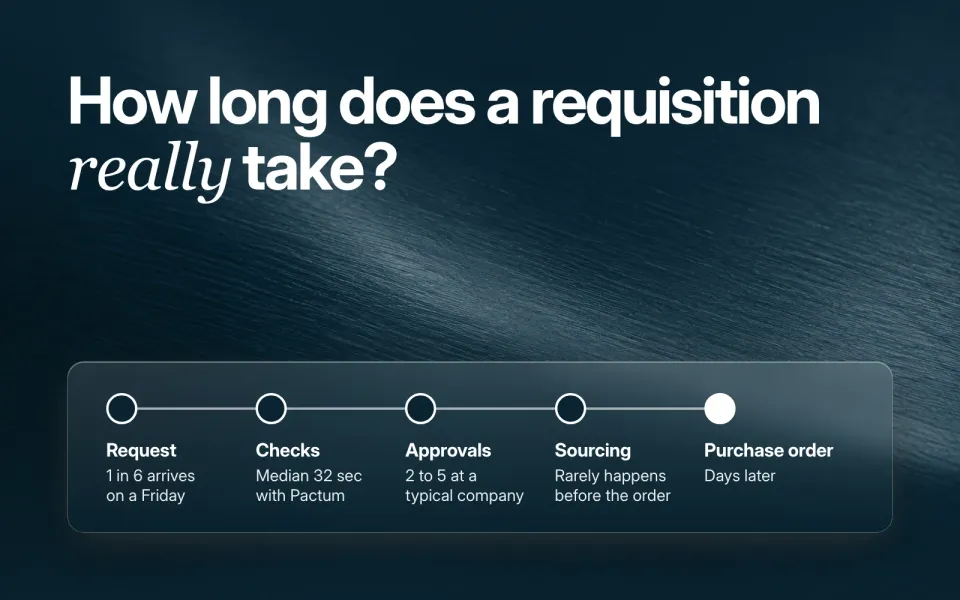
Pactum's Alignment Agents run 50,000+ requisition checks a month. They're quick too, because 32 seconds is the median time to check a request against all its policies (how long requisition approval takes). More on the Alignment Agent page.
3. Sourcing
Sourcing Digital Workers get quotes on routine buys and run events with your buyers, on the route your rules pick, so each buy gets the right amount of competition.
- Lets your rules pick the route for every request, based on intake and alignment
- Gets several quotes on the buys nobody had time to put out to tender, which is big money for no extra work
- Runs the complex events with your buyers and helps them secure better deals
Pactum's Tactical Sourcing Agent delivers an 11% average saving on tactical buys that closed with a saving. See the Tactical Sourcing Agent and the Advanced Sourcing Agent.
4. Negotiation
Pactum's Negotiation Agents chat with suppliers and agree terms inside the limits you set, and that includes the deals that have only one supplier.
- Negotiates single-source buys before the PO exists to eke out extra savings
- Chats with suppliers in 50+ languages, so you can scale globally without friction
- Puts a few offers on the table, each worth the same to you
- Trades price against payment terms inside your limits (and more, but let's start there)
See the Single-Source Negotiation Agent and the Post-Sourcing Negotiation Agent.
5. System of record
Every result goes back into your system of record through Pactum's integrations, so the record stays whole and nobody retypes a thing.
- Writes every result back into Coupa, SAP Ariba, or wherever your system of record lives
- Attaches an audit report to every check, so the trail is always there
- Never leaves a request stuck
6. Procurement brain
The procurement brain is how one set of rules reaches every request, whoever raised it and whichever layer picks it up.
- Your policies, category strategy, and preferred suppliers, written once and constantly learning and improving
- Followed by every Digital Worker, on every request, without fail
Which procurement workflows are best suited for AI agents?
The workflows best suited for AI agents are the high-volume, rule-bound ones that touch every request: intake, requisition checks, routine quotes, negotiating routine and single-source deals, and writing the record back. Category strategy and key supplier relationships stay with people, and buyers lead the complex sourcing events with Digital Workers running them alongside.
A simple test helps. If a task happens hundreds of times a week and the right answer can be written down as a rule, a Digital Worker should be doing it.
What controls does autonomous procurement need?
Autonomous procurement needs the controls a good procurement team already has, built into the Digital Workers from the start: written rules, limits on every decision, a person for anything outside them, and a full audit trail. In an AI-native team those controls live in the procurement brain: Alignment enforces the buying rules on every request, and every negotiation keeps to its limits.
- Rules written once, in one place, that every Digital Worker follows
- Limits on every negotiation, such as your price targets, the payment terms it may offer, and the suppliers it must not use
- A buyer for anything outside those limits
- Every result written back to your system of record, with an audit report on every check
- Observer mode, where the Alignment Agent runs on real requests and records what it would have done before it is allowed to act
Controls also help decide whether AI projects survive. Gartner predicts over 40% of agentic AI projects will be canceled by the end of 2027, due to escalating costs, unclear business value or inadequate risk controls, which is why the rules, limits, and trail belong in the design from day one.
What happens to the procurement team?
Autonomous procurement takes the routine volume off the team, so people move up to the work only they can do. Buyers run the complex events, manage key suppliers, and own category strategy, while the Center of Excellence writes and owns the rules the Digital Workers follow.
Volume also stops being a hiring question. At Pactum's largest deployment, Pactum's Digital Workers mean 122,000+ requisitions a year absorbed with no added headcount.
Across the six layers, the work splits like this.
| What the Digital Workers do | What people own | |
|---|---|---|
| Intake Agent | Turn plain requests into finished requisitions | The buying channels and catalogs on offer |
| Alignment Agents | Check and enforce the buying rules on every request | The rules, and the requests sent back to them |
| Sourcing | Get quotes and run events on the route your rules pick | Complex events and category strategy |
| Negotiation | Negotiate with suppliers inside your limits | The limits, and anything outside them |
| System of record | Write every result back with an audit trail | The record and its reporting |
| Procurement brain | Follow one set of rules on every request | Writing and updating those rules |
Intake Agent
- What the Digital Workers do
- Turn plain requests into finished requisitions
- What people own
- The buying channels and catalogs on offer
Alignment Agents
- What the Digital Workers do
- Check and enforce the buying rules on every request
- What people own
- The rules, and the requests sent back to them
Sourcing
- What the Digital Workers do
- Get quotes and run events on the route your rules pick
- What people own
- Complex events and category strategy
Negotiation
- What the Digital Workers do
- Negotiate with suppliers inside your limits
- What people own
- The limits, and anything outside them
System of record
- What the Digital Workers do
- Write every result back with an audit trail
- What people own
- The record and its reporting
Procurement brain
- What the Digital Workers do
- Follow one set of rules on every request
- What people own
- Writing and updating those rules
What new roles will AI create in procurement?
A new wave of procurement roles is forming around Digital Workers, and it's early, so expect the titles to move. Some teams already have AI sourcing roles, and people like Lizza Parbst at Otto Group, who grew from a junior procurement controller into the product manager for autonomous negotiations, are already taking on new roles and responsibilities running and managing Digital Workers. The next step looks like AI architects who design the team and procurement AI engineers who write the rules in the brain and set the negotiation limits. We're still working out what these roles look like with the teams we work with.
Where should a procurement team start with AI agents?
Procurement leaders move from AI pilots to scaled adoption one layer at a time, starting with one layer in observer mode on real requests. Alignment is the natural first layer, because it touches every request, shows you exactly what it would decide, and makes every layer after it safer.
- Observer mode. The Digital Worker runs on every real request and records what it would have done, with no effect on the process.
- Advisor mode. It tells your reviewer what it found and why, and your people make the call.
- Fully autonomous. Once a rule outperforms your own reviewers, it approves clean requests on its own, inside your rules, and sends the rest back with the reason.
Then add the next layer, with people reviewing its work at first. Start each layer with written rules and an agreed measure, so the team can see when it has earned more autonomy.
For a Center of Excellence, that order is usually requisition checks first, then intake, then sourcing and negotiation, with the CoE owning the rules in the brain from day one. There's more on that in how a procurement Center of Excellence scales without headcount.
How should procurement teams measure ROI from AI agents?
Measure an AI-native procurement team on time, coverage, savings, capacity, and trust: how fast each request is handled, how much of your spend gets worked on, what that work returns, how much volume it takes on, and how often its calls match your reviewers' decisions.
- Time: from a request arriving to a checked request
- Coverage: the share of requests and spend that get checked, quoted, or negotiated
- Savings: the savings and payment terms on the deals it wins
- Capacity: the requests handled without adding headcount
- Trust: how often its decisions match your reviewers' decisions
Where Pactum comes in
Pactum's Digital Workers are the four working layers of an AI-native procurement team, working within the system of record you already use, such as Coupa, SAP Ariba or SAP S/4HANA.
Intake Agent
Lets requesters ask in plain words, then works out the buying route and writes the requisition.
Alignment Agent
Checks and enforces your buying rules on every requisition it is sent, brings in the right approver, and approves the ones that pass.
Sourcing and negotiation Digital Workers
The Tactical Sourcing Agent gets competitive quotes, the Advanced Sourcing Agent runs complex events with your buyers, and the Single-Source Negotiation Agent negotiates with the named supplier, all inside the limits you set.
The video above runs one full day, sunrise to moonset, and the floors never go quiet. This is what we do at Pactum, it's why I joined, and it's a clear vision for autonomous procurement where we work hand in hand with Digital Workers.
FAQ
What is autonomous procurement?
Autonomous procurement is procurement where Digital Workers do the routine work themselves, taking requests, checking them against your rules, getting quotes, negotiating with suppliers, and writing the result back, inside limits your team sets. Pactum's Digital Workers run indirect procurement this way, from intake to purchase order, guided by your policies and strategy.
What are digital workers in procurement?
Digital workers in procurement are AI agents that each own a procurement job, such as intake, requisition checks, sourcing, or negotiation, and do it on every request they are given. Pactum's Digital Workers work inside your approval flow and write their results back into your system of record.
What is agentic AI in procurement?
Agentic AI in procurement means AI agents that do procurement work themselves instead of only suggesting it: they take requests, check them against your rules, get quotes, negotiate with suppliers, and write the result back. With Pactum's Digital Workers, people set the rules and limits and handle anything outside them.
What is the difference between autonomous procurement and procurement automation?
Procurement automation moves a request along a fixed path, such as routing a form to the next approver. Autonomous procurement has Digital Workers doing the work inside that path, one after another: reading the request, checking it, sourcing it, negotiating it, and recording it, with people stepping in where judgment is needed.
What does an autonomous procurement operating model look like?
An autonomous procurement operating model runs in six layers: Digital Workers do the work in four of them (Intake, Alignment, Sourcing, and Negotiation), and they stand on the other two, the system of record and a procurement brain that holds the rules. With Pactum's Digital Workers, buyers own category strategy, complex events, and key suppliers, and the Center of Excellence owns the rules.
What does a mature AI operating model for procurement look like?
A mature AI operating model for procurement has every layer, from intake to negotiation, acting on its own inside written limits, with the Center of Excellence owning the rules and buyers handling the exceptions, complex events, and key suppliers. It gets there one layer at a time, each moving from observer mode to fully autonomous as it earns trust.
Which procurement workflows are best suited for AI agents?
The workflows best suited for AI agents are high-volume and rule-bound: request intake, requisition checks, getting quotes on routine buys, negotiating routine and single-source deals, and writing results back to the system of record. Category strategy and key supplier relationships stay with people, and buyers lead the complex sourcing events with Digital Workers running them alongside.
What controls are needed for autonomous procurement?
Autonomous procurement needs written rules every Digital Worker follows, limits on every negotiation such as price targets and allowed payment terms, a buyer for anything outside those limits, an audit report on every check, and an observer mode where the Digital Worker runs on real requests and records what it would have done before it is allowed to act. Pactum's Digital Workers are built around these controls.
How can procurement leaders move from AI pilots to scaled AI adoption?
Move from pilots to scale one layer at a time: start with requisition checks in observer mode on real requests, agree how they will be measured, and let a rule act on its own only once it outperforms your own reviewers. Then add the next layer, such as intake or negotiation, with a buyer reviewing its work until it earns more autonomy.
What are the first procurement processes a center of excellence should automate with AI?
A center of excellence should start with requisition checks, because they touch every request and show exactly how the AI applies your rules before it acts. Intake usually comes next, then sourcing and negotiation, with the center of excellence owning the rules every Digital Worker follows.
What is the best AI adoption roadmap for a procurement center of excellence?
The best roadmap is layer by layer: requisition checks in observer mode first, then advisor mode, then fully autonomous once a rule outperforms your reviewers, before adding intake, sourcing, and negotiation the same careful way. The center of excellence writes and owns the rules throughout, so every Digital Worker follows one set of policies.
What new roles will AI create in procurement?
AI is creating new procurement roles around Digital Workers, and it is early, so expect the titles to move. Some teams already have AI sourcing roles and people who own autonomous negotiation and AI, and roles such as AI architects and procurement AI engineers, who design the team, write its rules, and set its limits, look likely to follow.
How should procurement teams measure ROI from AI agents?
Measure AI agents on time, coverage, savings, capacity, and trust: how fast each request is handled, how much of your spend gets checked, quoted, or negotiated, the savings and payment terms on the deals they win, the volume handled without added headcount, and how often their decisions match your reviewers' decisions. Pactum reports these for its Digital Workers.