What is guided buying in procurement?
31 percent
of procurement teams told Pactum about problems that send purchase requests off catalog.
Pactum conversations with procurement teams, May to November 2026.
TL;DR
If you only have 30 seconds, here's what you need to know:
- Guided buying is a self-service buying experience, usually inside a procurement suite, that steers requesters to the right channel and applies policy as they go. It's built for occasional buyers in indirect spend, who pick from the catalogs, suppliers, and forms procurement has set up.
- Catalog buying is one buying channel, and guided buying is the layer that steers the requester to a channel. Checking each requisition at submission is a third layer.
- Purchase requisitions still go off catalog when a request doesn't fit the guided path, or when the requester goes around a path that's already there. In Pactum's conversations with procurement teams between May and November 2026, 31% told us about problems that send purchase requests off catalog, most often that free text is a big share of requests, that catalogs or supplier lists are missing or out of date, or that guided buying doesn't cover everything. When the request is a conversation with Pactum's Digital Workers, the requester no longer has to find the path at all.
- Maverick spend is buying outside a preferred channel, supplier, or price that already exists, and the requisition is the last point to catch it before a purchase order. Efficio's 2025 survey of CPOs, CFOs, and senior leaders at large European companies found that 93% cite maverick spending as a major contributor to leakage in indirect spend.
- What comes after guided buying is a new way to buy, where requesters ask in plain words and Digital Workers do the buying work under the rules procurement sets. Pactum's Alignment Agent, one of its Digital Workers inside Coupa and SAP Ariba, runs 50,000+ requisition checks a month.
- Purchase requests use existing contracts and catalog prices when each requisition is checked against the company's buying rules as it's submitted. When one is off, Pactum's Digital Workers tell the requester or an approver the right route and what to change, and they approve the ones that pass.
- AI agents choose between a catalog buy, a contract, and a sourcing event by applying the buying rules procurement has set. Pactum's Intake Agent works out the route before it writes the requisition, and the Alignment Agent checks it again after submission and points it to the right route if it's off.
- A purchase requisition that names only one supplier can go to competition before it becomes a purchase order. Pactum's platform data shows that running a buy as a competition brings 2x the saving of negotiating with a single supplier.
Key numbers
What procurement teams tell Pactum
31%
of procurement teams told Pactum about problems that send purchase requests off catalog.
Pactum conversations with procurement teams, May to November 2026
24%
of procurement teams told Pactum that spend goes through untested.
Pactum conversations with procurement teams, May to November 2026
11%
of procurement teams told Pactum that people buy around procurement or off contract.
Pactum conversations with procurement teams, May to November 2026
What the research says
93%
of European CPOs, CFOs, and senior leaders cite maverick spending as a major contributor to leakage in indirect spend.
Efficio, The illusion of control in indirect spend, October 2025
85%
of European CPOs, CFOs, and senior leaders say more than a quarter of their indirect spend has no financial oversight.
Efficio, The illusion of control in indirect spend, October 2025
75%
of procurement professionals cite a lack of self-service or guided buying tools as one of the biggest causes of maverick purchases.
The Hackett Group, Maverick Spend Report, March 2019
16%
of negotiated savings can be lost to maverick spend, respondents believed.
The Hackett Group, Maverick Spend Report, March 2019
Pactum's platform data
50,000+
requisition checks a month run by Pactum's Alignment Agent, inside Coupa and SAP Ariba.
Pactum platform data, 30 days to 21 October 2026
2x
the saving of negotiating with a single supplier, when a buy runs as a competition.
Pactum platform data, 12 months to September 2026
How does guided buying work?
Guided buying works by taking a requester through a self-service path, usually inside a procurement suite, to the right buying channel, whether that's a catalog item, a punch-out to a supplier's own site, a request form, or a quote request. It applies the company's purchasing policy along the way.
Guided buying is built for occasional buyers, such as an engineer ordering a monitor or a marketer booking an event venue, rather than for professional buyers, and it mostly covers indirect spend.
Guided buying works well wherever a company has current catalogs and a clear preferred supplier list, and the buy fits what's in them. With catalogs behind it, it's why most large companies don't need procurement to touch every pen and printer cartridge.
How is guided buying different from catalog buying?
Catalog buying is one buying channel, where the requester picks a pre-approved item at a negotiated price, and guided buying is the layer on top that steers the requester to the right channel and applies policy on the way in. Checking requisitions at submission is a third layer, which looks at what was actually requested.
| Catalog buying | Guided buying | Requisition checks at submission | |
|---|---|---|---|
| What it is | Picking a pre-approved item at a negotiated price | A guided path to the right channel, with policy applied along the way | A check of each submitted requisition against the company's buying rules, pointing it to the right route when it's off |
| What it covers | Items in a catalog or punch-out | Catalog items, punch-out, forms, quote requests, and non-catalog requests | Every requisition sent to it, free text included |
| When it acts | When the requester picks an item | While the requester is shopping | The moment the requisition is submitted |
| What it needs | The item in a catalog or punch-out | Current catalogs, preferred supplier lists, and forms | The company's buying rules, and a requisition raised for the purchase |
Catalog buying
- What it is
- Picking a pre-approved item at a negotiated price
- What it covers
- Items in a catalog or punch-out
- When it acts
- When the requester picks an item
- What it needs
- The item in a catalog or punch-out
Guided buying
- What it is
- A guided path to the right channel, with policy applied along the way
- What it covers
- Catalog items, punch-out, forms, quote requests, and non-catalog requests
- When it acts
- While the requester is shopping
- What it needs
- Current catalogs, preferred supplier lists, and forms
Requisition checks at submission
- What it is
- A check of each submitted requisition against the company's buying rules, pointing it to the right route when it's off
- What it covers
- Every requisition sent to it, free text included
- When it acts
- The moment the requisition is submitted
- What it needs
- The company's buying rules, and a requisition raised for the purchase
Why do purchase requisitions still go off catalog?
Purchase requisitions go off catalog when a request doesn't fit the guided path, or when the requester goes around a path that's already there.
That's what procurement teams describe on their calls with Pactum. One large health system said its non-catalog route was designed to be the exception and hasn't been the exception since the day it went live, and a category manager at a food ingredients company guessed that most of the free-text requests they review are for things already bought by the time the requisition arrives.
In Pactum's conversations with procurement teams between May and November 2026, 31% told us about problems that send purchase requests off catalog: 12% that free text is a big share of their requests or a problem, 8% that guided buying doesn't cover everything, and 7% that requesters don't know where or how to buy. These are the usual reasons:
- The catalogs or supplier lists are missing or out of date (8% of teams). Guided buying steers by the data it's given, so requesters go elsewhere when nobody has refreshed the catalogs, negotiated discounts never reached the catalog price, or the preferred supplier list was never formalized.
- People buy first (7% of teams). The requisition is raised after the purchase, sometimes with the invoice already attached.
- The requester doesn't know what exists (5% of teams). A catalog, a contract, or a preferred supplier is already there, and the person raising the request has no idea.
- The buy doesn't fit a catalog. Services, capital equipment, one-off items, and bundles sit badly in a catalog or a fixed form.
- People stick with familiar suppliers. A buyer likes their local supplier, or someone has already agreed terms with a supplier they know, so the requisition goes in with that supplier's name on it even where a preferred supplier exists.
In March 2026, The Hackett Group made the same point about buys that don't fit: structured intake works when categories are well defined, catalogs are current, and policy is uniform, but it struggles with services, bundles, and one-off needs.
Urgency came up least of the issues we counted. In Pactum's conversations with procurement teams between May and November 2026, 3% told us urgency is a reason requests skip the process.
Most of these reasons come from the same design. Guided buying asks the requester to find the right path: to know what's in the catalog, pick the right form, and choose a supplier procurement has already approved. Someone who buys a few times a year doesn't know any of that, so they type what they need into a free-text box, stick with the supplier they know, or buy first and raise the requisition later.
When the request is a conversation, the requester doesn't need to know any of it. They ask for what they need in plain words, and Pactum's Digital Workers do the work the guided path leaves to them: they find the catalog item or contract the company already has, write the requisition, check it against the company's buying rules, work out the buying route, and source or negotiate the buy before the purchase order when the company's rules call for it. A requester can't go around a path they never have to find, and a buy that doesn't fit a catalog no longer has to be forced into one.
What is maverick spend and how do you stop it?
Maverick spend is "the buying of goods or services outside of a preferred buying channel, supplier or price when one has already been established," in The Hackett Group's definition. It's also called rogue spend or off-contract spend. Guided buying prevents much of it by making the compliant route the easy one, and you catch the rest at the requisition by checking each one as it's submitted against the catalogs, contracts, and preferred suppliers already in place. Pactum's Digital Workers check requisitions this way before they become purchase orders. Spend that never reaches a requisition, such as card purchases, needs other controls.
A free-text requisition for an item that's already in the catalog is the clearest example. Two studies put numbers on maverick spend, and Pactum's own conversations point the same way:
- The Hackett Group's 2019 Maverick Spend Report found that 75% of procurement professionals cite a lack of self-service or guided buying tools as one of the biggest causes of maverick purchases, and its respondents believed as much as 16% of negotiated savings are lost to maverick spend.
- Efficio's 2025 survey of 300 CPOs, CFOs, and senior leaders at large European companies found that 93% cite maverick spending as a major contributor to leakage in indirect spend. In the same survey, 85% say more than a quarter of their indirect spend has no financial oversight, even though more than 90% say they uphold pre-approval processes.
- In Pactum's conversations with procurement teams between May and November 2026, 11% of teams told us people buy around procurement or off contract.
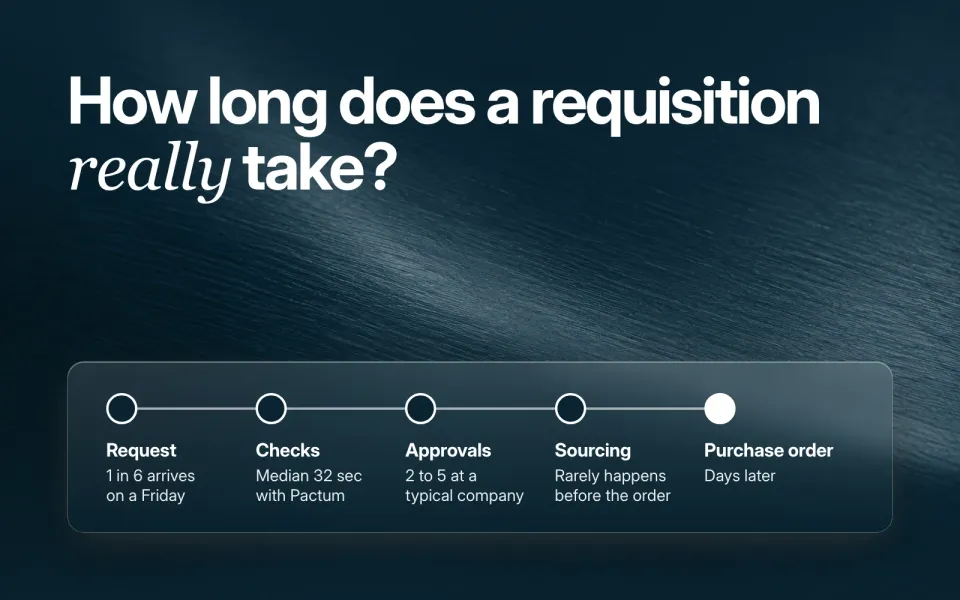
Pre-approval decides whether a request may go ahead, and it rarely checks whether the item was already in a catalog or under a contract. There's more on how long purchase requisition approval takes.
What comes after guided buying?
What comes after guided buying is a new way to buy, where requesters ask for what they need and Pactum's Digital Workers, AI agents that work inside Coupa and SAP Ariba, do the buying work under the rules procurement sets. Guided buying made the old way easier to follow, but it still asks a requester to find the path and still leaves procurement to check what comes out the other end.
For requesters, buying becomes a conversation instead of a manual intake process. They ask for what they need in plain words, in Microsoft Teams, Coupa, or SAP Ariba, and Pactum's Intake Agent works out the buying route and writes the requisition for them.
For procurement, the routine checking comes off its desk. The Alignment Agent checks every requisition a company sends it the moment it's submitted, free text included, against the catalogs, contracts, and preferred suppliers the company already has. It approves the ones that pass, and when one is off route, it sends it back to the requester or on to an approver with the right catalog item, contract, or supplier and what to change. That's the work that has your best procurement people clearing queues today.
In this new way of buying, procurement can deploy Digital Workers that do all of the sourcing and negotiation for them. At times they work fully on their own, negotiating with the named supplier before the purchase order without anyone needing to be involved. At times procurement only needs to check that the suppliers a Digital Worker has found are a good fit before it runs the competition. And at other times a Digital Worker works directly with a buyer on more complex sourcing, where human judgment is still so powerful and still needed.
How do you make sure purchase requests use existing contracts and catalog prices?
You make sure purchase requests use existing contracts and catalog prices by checking each requisition against the company's own buying rules as it's submitted. Pactum's Alignment Agent checks every requisition a company sends it and, when one is off route, tells the requester or an approver the right route to take. It runs 50,000+ requisition checks a month, and 32 seconds is the median time to check a request against all its policies.
Pactum platform data, 30 days to 21 October 2026.
The checks are the company's own rules, built from Pactum's rule library and the company's policies, and together they check that a request is compliant, on the right buying route (a catalog, a contract, or a new buy), with the right suppliers, and whether a single-supplier request should go to competition. A company can set up checks like these for off-catalog spend:
- A catalog check looks for the same item in the company's catalogs for any free-text line and tells the requester which catalog item to use, with its price and supplier.
- A buying channel check confirms the request used the channel the company mandates for it, such as a form, a punch-out, or a catalog.
- A contract channel check spots a requisition for a contracted supplier that should have been raised from the contract itself.
- An active contract check looks up whether the supplier already has an active contract the requisition should be linked to.
- A preferred supplier check confirms the chosen supplier is preferred for that category.
- A retrospective spend check spots a purchase made before the requisition, for example one with the invoice already attached.
The Alignment Agent then does what the company has set for each rule: add a note to the requisition, escalate it to an approver with the finding attached, or return it to the requester with the reason and what to change. It approves a requisition that passes every check, so the requisition needs fewer human approvals or none. See what a bad requisition costs once it becomes a purchase order.
How do AI agents decide between a catalog buy, a contract, and a sourcing event?
AI agents decide between a catalog buy, a contract, and a sourcing event by applying the company's own buying rules to each request. Pactum's Digital Workers, AI agents that work inside Coupa and SAP Ariba, apply those rules before the requisition is written and again once it's submitted.
A catalog fits when an approved item exists, and a contract when an agreement already covers the supplier or item. When neither does, the buy is new: below the company's competition threshold it can go through as a one-off purchase, and above it, or wherever the rules call for competition, it goes to a sourcing event.
Pactum's Intake Agent works out the route before it writes the requisition, asking the requester for anything that's missing and checking the catalog as it goes. The Alignment Agent checks the route again once the requisition is submitted and points an off-route request to the right one, so a request that started in the wrong place still ends up on the right route. Each Alignment Agent rule starts in observer mode, where it records what it would have decided without acting, and procurement teams move it to advising, then acting, once its decisions agree with their own reviewers'. See how agentic AI works in procurement.
What happens when a purchase requisition names only one supplier?
A purchase requisition that names only one supplier can go to competition before it becomes a purchase order. When the company's rules call for competition, Pactum's Tactical Sourcing Agent steps in further along the approval flow and suggests competing suppliers, picked from suppliers the company already buys from in the same category and delivery location, each with the reason it was chosen.
A buyer keeps or drops each suggestion, and the agent then asks the chosen suppliers for quotes and negotiates the final terms. The Single-Source Negotiation Agent negotiates with the named supplier before the purchase order when the company's rules keep the buy with it, or when there's no one else to ask. Running a buy as a competition brings 2x the saving of negotiating with a single supplier.
Pactum platform data, 12 months to September 2026.
In Pactum's conversations with procurement teams between May and November 2026, 18% told us that requisitions naming one supplier or one quote go through without competition or negotiation, or that much of their spend is never negotiated.
"I worked with buy desks whose whole job was to get every requisition right, and single-source suppliers still got pushed through when the buy should have gone to competition."
Where Pactum comes in
Pactum's Digital Workers are AI agents that do the buying work across all of a company's spend, inside Coupa and SAP Ariba, which stay the system of record.
Intake Agent
Lets requesters ask in plain words in Microsoft Teams, Coupa, or SAP Ariba, then works out the buying route and writes the requisition.
Alignment Agent
Checks every requisition a company sends it, points an off-route request to the catalog item, contract, or preferred supplier the company already has, and approves the requisitions that pass.
Sourcing and negotiation Digital Workers
The Tactical Sourcing Agent takes a single-supplier requisition to competition when the company's rules call for it, and the Single-Source Negotiation Agent negotiates with the named supplier when they don't.
Most companies have spent real money building catalogs and negotiating contracts, so it's worth asking how many of this week's free-text requisitions were for something you already had.
FAQ
Does guided buying stop maverick spend?
Guided buying cuts maverick spend on anything that fits the guided path, because it steers requesters to the compliant route first. In Pactum's conversations with procurement teams between May and November 2026, 31% told us about problems that send purchase requests off catalog, and 11% that people buy around procurement or off contract. Free-text requisitions get the least steering on the guided path, so checking each one as it's submitted handles what guided buying misses, wherever a requisition is raised.
How do you stop non-catalog and free-text purchase requisitions?
You can stop them, but it means rethinking the whole request process. When requesters ask for what they need in plain words instead of typing a free-text line, a Digital Worker finds the catalog item or contract and writes the requisition for them, and the Alignment Agent checks every requisition as it's submitted against the catalogs, contracts, and preferred suppliers in place. A one-off buy with nothing in place still gets a requisition, but it's written from the conversation and checked like every other one. There is a way to do it through technology, but it does require a shift in how people think about procurement today. In Pactum's conversations with procurement teams between May and November 2026, 12% told us free text is a big share of their requests or a problem.
Is a free-text requisition always maverick spend?
A free-text requisition is maverick spend only when a catalog item, contract, or preferred supplier already exists for that purchase. A free-text request for a one-off service with nothing in place is the route working as designed, and the question then is whether it should go to competition.
How do you measure catalog compliance?
Catalog compliance is usually measured as the share of spend or requisition lines that goes through catalogs and punch-out, alongside on-contract spend. Track free-text lines that matched an item the company already had as a separate number, because that's spend it had already set up a catalog or contract to cover.
Does checking requisitions replace guided buying in your P2P suite?
No, the P2P suite stays the system of record, and checking requisitions works inside it alongside guided buying. Guided buying steers the requesters who use it, and Pactum's Digital Workers check what was actually submitted, point an off-route requisition to the right one, and take a buy to sourcing and negotiation when the company's rules call for it. Once requesters can ask for what they need in plain words, most no longer need the guided path at all.
Where do Pactum's figures from procurement teams come from?
Each figure is the share of procurement teams that told Pactum about an issue in sales and customer conversations about indirect procurement between May and November 2026, so it's a floor rather than a measure of how common the issue is, and a team can name more than one issue.