Pactum's Advanced Sourcing Agent drafts your RFP, negotiates every round and compares bids on value, so your buyer leads the event and gets the best deal.
Why are sourcing events still so hard to run?
Your facilities services contract expires in three months. That’s 12 sites, five services, and a current supplier who has been quietly raising the prices every year since you signed.
Time to run an RFP. Get it right and the savings last for years. Get it wrong and you’re stuck with the cost until the contract runs out.
Running an RFP is still a long, manual process. You know exactly what you need. Every supplier quotes what they want to sell you. And closing that gap takes weeks of this:
Gather the requirements
Site lists, service levels, last contract's rates and input from every site manager. All in different places, of course.
Build the RFP from scratch
Twelve sites, five services, every service level. That's 60 line items before a single supplier sees it.
Send it out and chase
Then chase again. And again, for the supplier who promised to "get back to you by Friday."
Work out what each supplier actually quoted
One prices 9 of your 12 sites. Another bundles snow clearing into the monthly fee. A third quotes a three-year term you never asked for.
Compare the bids
Line by line. What's in scope, what's missing, and what's extra.
Find the real cost
The cheapest monthly fee comes with a charge for every call-out. The pricier one includes 24/7 response. So which one is actually cheaper over three years?
Ask for a better offer
"Can you revise your quote?" Then compare the new numbers. Then do it all again when the next revision lands.
Get your stakeholders to agree
Site managers want the supplier they know, and finance wants the lowest price. Cue the meetings.
Award it and write it up
Into the system that holds the contract, plus a note for audit explaining why this supplier won.
Something has to give. So the lowest monthly fee wins after one round, and the call-out charges arrive a month later. Yes, the very cost your category strategy was supposed to control.
Or the contract expiry sneaks up, nobody is free to run the RFP, and the current supplier renews at whatever price they ask. And they know it.
Doesn’t your sourcing tool already fix this?
To be fair, sourcing tools have made a real difference. Every bid lands in one place, and there are no more attachments flying around the inbox.
But a sourcing tool collects the bids. It doesn’t go back to the suppliers for a better offer. Your buyer still has to:
- Build the RFP
Every requirement, every site and every line item, typed in by hand.
- Make sense of the bids
The portal collects them. Comparing them is still your job.
- Find the real cost
Call-out charges, response times and a three-year term don't add themselves up.
- Run every round
Each "can you revise your quote?" means another email and another wait.
- Write up the award
And explain to audit why the cheapest bid didn't win. Or why it did.
The tool holds the bids. Your buyer still does the work.
And what about the AI features some tools now add, surely they help? They’ll suggest which supplier looks best or draft a summary of the bids. Handy. But someone on your team still has to chase every revision and run every round.
Today there are two types of AI in procurement. There’s AI that helps you work, but stops at recommendations and hands the work back to your buyer. And there’s AI that does the work and actually takes it off your hands.
Your buyers know how to run a great RFP. What they don't have is weeks to spare for every step done by hand.
What if your buyer only had to set the strategy and pick the winning supplier, and everything in between got done for them?
What is an Advanced Sourcing Agent?
Pactum’s Advanced Sourcing Agent is a buyer-led AI agent for complex, high-value sourcing events. It builds the event, collects the bids and negotiates with every supplier, round after round, until you have ranked final offers to award.
Think of it as a sourcing analyst who never runs out of time and never forgets to send the follow-up email. It does the drafting, the chasing and the negotiating, and your buyer makes every call that needs judgment.
It’s one of Pactum’s AI agents for indirect procurement. Everyday requests run autonomously from intake to PO in under a day. Advanced Sourcing takes on the big, complex events where your buyer’s judgment matters most.
Here’s what it takes off your buyer’s desk:
- Builds the event
Your buyer describes the need in plain language or uploads a spec or scope document, and the agent drafts the RFP from there. No blank page.
- Collects every bid
Suppliers bid through a simple link, on the full scope or on just the part they specialize in.
- Negotiates any term you need
Rate cards, quantities, SLAs and commercial terms are all on the table, and it pushes hardest on the terms you told it matter most.
- Compares bids on value, not only price
It weighs every term the way you would. So the cheapest monthly fee with a charge for every call-out doesn't get to pass itself off as the best deal.
Your buyer stays in charge. They just stop spending weeks chasing suppliers for revised quotes.
Find the best deal in every sourcing eventSee how AI drafts the RFP, negotiates every round and compares every bid on value while your buyer decides.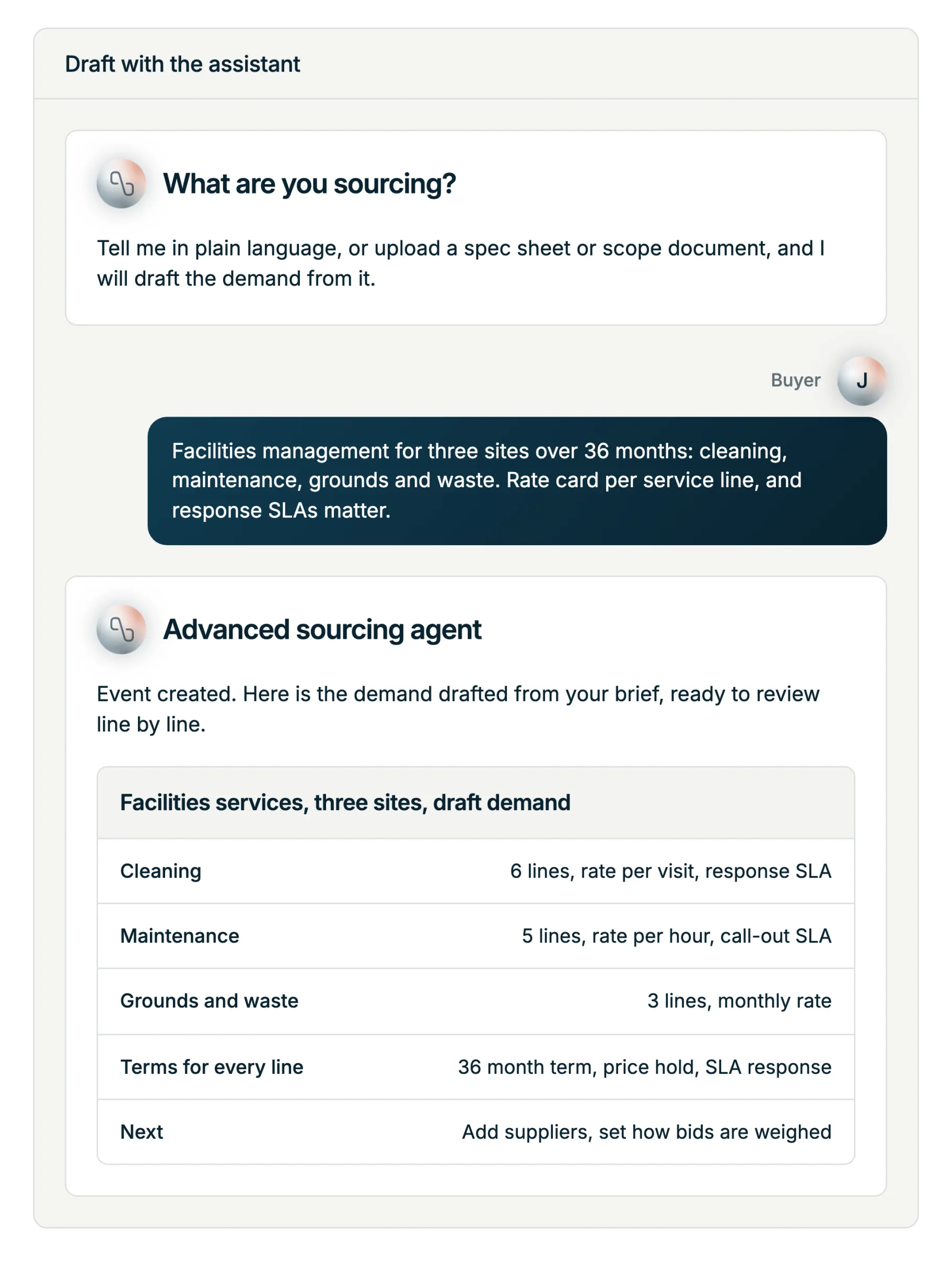
How does an Advanced Sourcing Agent work?
No, the AI doesn’t get to go rogue on your facilities contract. Your buyer sets the guardrails first, covering who gets invited, which terms matter most and how many rounds to run. The agent works inside those lines, and your buyer can jump in at any point.
And there’s no shiny new system to roll out. Pactum works with Coupa, SAP Ariba and Microsoft Teams, and the award is ready for your contract system the moment your buyer signs off.
How it works
From brief to award
Brief
Plain language or a scope document.
Draft
The RFP, line by line.
Bid
Full scope or just one part.
Negotiate
Every supplier, every round.
Compare
Every offer, on value.
Award
Your buyer makes the call.
Here’s how the facilities RFP plays out:
Your buyer shares the brief
Your buyer describes what they need in plain language or uploads the scope document, covering the 12 sites, the five services and the service levels they've already agreed with the business.
What you get: a head start, with nothing typed in by hand.The RFP gets drafted
The agent turns the brief into an RFP, line by line, with sections, line items and terms. Your buyer reviews it and chooses which suppliers to invite before anyone sees it.
What you get: a complete RFP, built your way, ready to send.Suppliers bid
Suppliers bid through a simple link. They can bid on the full scope or on just the services they specialize in, which means smaller, specialist suppliers finally get a fair shot.
What you get: every bid in one place, including from specialists who would never bid on the full scope.It negotiates every round
The agent counters every bid on your buyer's behalf, pushing hardest on the terms your buyer said matter most, from price to rate cards to SLAs. No supplier ever sees another's bid. And suppliers don't mind, because 85% of suppliers would rather negotiate with AI than with a human buyer.
What you get: a better offer from every supplier, without the email chain. Here's more on how agentic AI negotiates.Every offer gets compared on value
Bids are compared on value across every term, not on price alone, and the final offers come back ranked. Your buyer doesn't get a summary to check. They get the comparison, already done.
What you get: the full picture of every offer, ready for your evaluation.Your buyer awards the contract
Your buyer makes the award, and every bid and every message is on record. Already ran an RFP somewhere else? Post-Sourcing Negotiation can still go back to every shortlisted supplier for a better final offer before you award.
What you get: the best deal, a human decision, and a full audit trail.
Weeks of drafting, chasing and negotiating, done by your AI workforce. Your buyer just makes the calls.
Does AI actually reduce procurement team workload?
Yes, as long as the AI does the work and doesn’t just tell you what to do next. Remember the to-do list from the facilities renewal? Here’s who takes care of each item now.
| On your buyer’s to-do list | Now handled by Pactum’s AI agents |
|---|---|
| Typing out 60 line items from scratch | Your buyer shares a brief or uploads the scope, and the RFP is drafted line by line |
| Chasing the supplier who promised a reply “by Friday” | Suppliers get one link and bid in one place |
| “Sorry, we only do security” | Partial bids, so specialists can compete too |
| The cheapest monthly fee, plus a charge for every call-out | Every offer compared on value across every term, not on price alone |
| “Could you revise your quote?” Round three. | The agent counters every bid between rounds, on the terms you care about |
| Writing up the award for audit | Every bid and message is on record, and the outcome is ready for your contract system |
What are the benefits of an Advanced Sourcing Agent?
So which procurement workflows are best suited for AI agents? The ones nobody went into procurement to do. Typing up line items, chasing the supplier who said “by Friday”, and asking for a revised quote for the third time. Your buyer keeps the decisions. The AI agent takes the rest.
That means bigger savings on your biggest contracts and your weeks back on every event. Here’s what procurement teams running Pactum’s AI agents are seeing across their organizations:
Your RFP drafted for you, not from scratch
You know the moment. The renewal notice lands, the contract ends in six weeks, and nobody has started the RFP. By the time it’s written, there’s no time left to run it properly. So you renew with the same supplier at the same price. Or a little higher, because they know you’re out of time.
With Pactum, writing the RFP becomes the quick part. Your buyer shares a brief or uploads the scope, and the agent drafts it line by line, ready for review. The weeks that used to go into writing go into running a proper event, and your best procurement people stop clearing queues.
You stop renewing just because the clock ran out. Every contract gets a real competition before it expires, and savings that used to roll into the next term stay with you.
Negotiate the whole deal, not just the day rate
Every procurement team has been burned by the cheap option. The consulting firm with the lowest day rate bills for travel, admin and every “out of scope” request. Six months in, it’s the most expensive firm on your list.
So how can AI improve supplier negotiations in procurement? By negotiating every term that drives the real cost, including the ones nobody had time to push on. Pactum’s AI agent negotiates rate cards, quantities, SLAs and commercial terms, not just the day rate.
And yes, AI really can negotiate. It pushes hardest on the terms you said matter most, then compares every offer on value. So the firm with the low day rate and a long list of extras finally gets compared with the one that includes them, on what each will actually cost you.
Finance sees the real cost before the contract is signed, not when the invoices arrive. And the savings come from every line of the deal, not just the headline rate.
More bidders, because specialists can quote on part of the scope
The best security firm in the region can’t bid on your facilities RFP, because the RFP also asks for cleaning, maintenance and waste. So the full-service supplier wins by default, and you pay their security rates. Convenient for them, but expensive for you.
With Pactum, suppliers can bid on just the part they do best. The security specialist quotes on security, the full-service supplier quotes on everything, and every bid gets compared on value. It’s how even small suppliers become win-win deals.
More bidders means sharper prices on every part of the scope. And with a broader supplier base, one supplier’s price rise or bad quarter doesn’t automatically become your problem.
Your AI workforce brings in the suppliers your team never had the bandwidth to chase, and turns that competition into savings.
You steer, the AI agent does the rounds
Let’s be honest. Round one is usually the final round. Your buyers know a second round pays off. They just can’t face another week of emails to get one.
So how do you reduce the time your team spends on negotiations? Let Pactum’s AI agent run the rounds. It counters every bid, round after round, while your buyer watches the offers move and steps in only when they want to. Here’s more on how autonomous negotiations work.
And going back really does pay. In 31% of events, someone overtakes the round-one leader before the final offers are in. So if you’d stopped at round one, you’d have picked the wrong winner.
Can we negotiate contracts while maintaining supplier relationships? Yes. Every supplier gets the same fair process and the same chance to improve their offer, and nobody gets an awkward “is that really your best price?” call.
More rounds, better offers, and not one extra email for your buyer.
An award you can defend, with a full record of every round
We’ve all been there. The contract was signed months ago, and now finance wants to know why you picked this supplier. Time to dig through six weeks of email threads.
Pactum’s AI agents keep every bid and every message on record, from the first round to the last. The final offers come back ranked and compared on value, so the reason one supplier came out ahead is right there.
When finance or audit asks “why this supplier?”, the answer is already on file. Yes, even when the cheapest bid didn’t win.
Your buyer still decides who wins. They just never have to rebuild the story from their inbox again.
Run more sourcing events without adding headcount
Somewhere in your contract list, there’s a SaaS renewal that rolled over again, a contract labor agreement nobody has looked at in three years, and a rate card that hasn’t moved since before the last price rise.
Nobody chose to leave them there. There’s just nobody free to run another RFP. So the suppliers keep naming their price, and you keep paying it.
Looking for procurement software that scales negotiations across categories? Pactum’s AI agents run the same structured process on every event, from professional services to SaaS renewals and contract labor. It’s one of the ways enterprise procurement leaders use AI to do more with the same team. Here’s what that gives your team:
- More events, same team
Your buyers make the decisions, and your AI workforce handles the drafting, chasing and negotiating.
- More spend under management
Contracts that used to roll over finally go out to suppliers.
- The same process on every event
Every RFP follows the same structured approach, whoever is running it.
Your team sets the strategy. Your AI workforce runs the sourcing events you never had the people for, and turns them into real savings.
 Customer story · Honeywell2,500+ supplier negotiations run by Pactum's AI agents: See how Honeywell runs thousands of supplier negotiations with Pactum's AI agentsRead the story
From intake to PO, run by Pactum’s AI agents
The Advanced Sourcing Agent is just one of Pactum’s AI agents for autonomous procurement. Together, they take every request from intake to PO, autonomously, in under a day.
So what does that look like? An employee says what they need in plain language, and Pactum’s AI agents take it from there. They check the request against your policy, fix anything that’s missing, negotiate a better deal or bring in more suppliers, and raise the PO. No forms, no queues, and nobody asking “any update on my request?” ever again.
Autonomous procurement
From intake to PO in under a day
And the best part is what it does for your people. Procurement sets the rules and the strategy, and your AI workforce does the work in between. Your buyers step in on the exceptions and the big calls, like leading an RFP with the Advanced Sourcing Agent.
Everyone wins. Employees get what they need faster. Finance sees up to 15% savings on spend that used to go straight to PO. And your buyers finally have time for supplier relationships, strategy and the decisions only people can make.
Your team keeps the decisions. Your AI workforce takes every request from “can I buy this?” to “done, and cheaper.”