Pactum's Single-Source Negotiation Agent negotiates every single-supplier requisition before the PO, so the spend nobody had time for finally gets a better deal.
Why does nobody negotiate when there’s only one supplier?
Your new site opens in two weeks, and the warehouse team needs 250 pairs of safety boots and a pallet of hi-vis jackets before the doors open.
They’re not in the catalog, so the site manager asks your usual industrial distributor for a quote. It comes back at $24,000, on 30-day payment terms. Your standard is 60.
There’s only one supplier involved, and your buyers are already buried in bigger deals. The approver opens the email between meetings, taps approve, and off it goes to PO.
Full price. Net 30. Not a single counteroffer.
And suppliers know it. If nobody ever asks for a better deal, they’ll keep quoting the same price, and you’ll keep paying it.
Sound familiar? Now multiply it by every off-catalog order, every one-off request, and every “we’ve always used them” supplier. That’s hundreds of POs a month that nobody ever negotiated.
Pull last month’s one-supplier POs out of Coupa or SAP Ariba, and the same patterns jump straight out:
- The quote becomes the price
Off-catalog and one-off orders go straight to PO, so the first number the supplier sends is the number you pay.
- Too small to negotiate, too big to ignore
A $24,000 order won't get a big distributor on the phone, and your buyers have bigger deals to chase. So nobody tries.
- Approvals happen from the inbox
Approvers are checking that the business needs it, not whether the price is right. And with buyer roles changing hands so often, nobody can keep track of every contract and preferred supplier.
- Smaller suppliers never hear from you
Plenty of suppliers have never been negotiated with once. They send a quote, they get a PO, and that's the whole relationship.
- Payment terms quietly drift
Your standard is 60 or 90 days, the supplier quotes 30, and it sails through. Yes, the very thing finance told you to watch out for.
- "Single source" becomes the excuse
The moment there's only one supplier, everyone assumes there's nothing to negotiate.
And if someone does decide to negotiate one? Congratulations, they’ve just signed up for a week of this:
- Your team still contacts the supplier
Finding the right person, writing the email, and waiting for a reply.
- Your team still has the back-and-forth
Every counteroffer needs an answer, often over several days.
- Your team still decides what to trade
Price, payment terms, or delivery, and how far to push without upsetting a supplier.
- Your team still updates the requisition
And checks that the PO matches what was agreed.
Your buyers have the skills. What they don't have is a spare week for every quote that lands in the inbox.
Repeat a few hundred times a month and something has to give.
We have thousands of unmanaged suppliers. How do we prioritize negotiations?
Let’s be honest. Your strategic suppliers get all the love. The other 80% of suppliers? You never get to them. Quote in, PO out, see you next year.
Welcome to the messy middle. It’s where the safety boots live, along with thousands of orders that are too small for a sourcing event, too frequent to ignore, and somehow nobody’s job.
Now imagine a buyer who never sleeps, never says “I’ll get to it next week,” and is weirdly excited about a $3,000 quote. That’s AI. It negotiates every order, every time, no favorites.
So your buyers keep the strategic suppliers, AI handles the other 80%, and the spend you never had time to manage finally starts paying you back.
What if every one-off order with a single supplier got negotiated before the PO, without anyone picking up the phone?
What is a single-source negotiation agent?
Pactum’s Single-Source Negotiation Agent is an AI agent that negotiates with your supplier when there’s only one on the order, before the purchase order is raised. It checks the details are right, then negotiates price, payment terms, delivery, and lead time, all within the limits you set.
Think of it as the friend who always asks “is that your best price?” Except it does it on every order, politely, and actually gets an answer.
And like all of Pactum’s AI agents for procurement, it works right where your team already does, inside Coupa or SAP Ariba. No new tool to roll out, no months-long IT project, and no more queues.
Never pay the quoted price againSee how Pactum's Single-Source Negotiation Agent negotiates every one-supplier order in Coupa.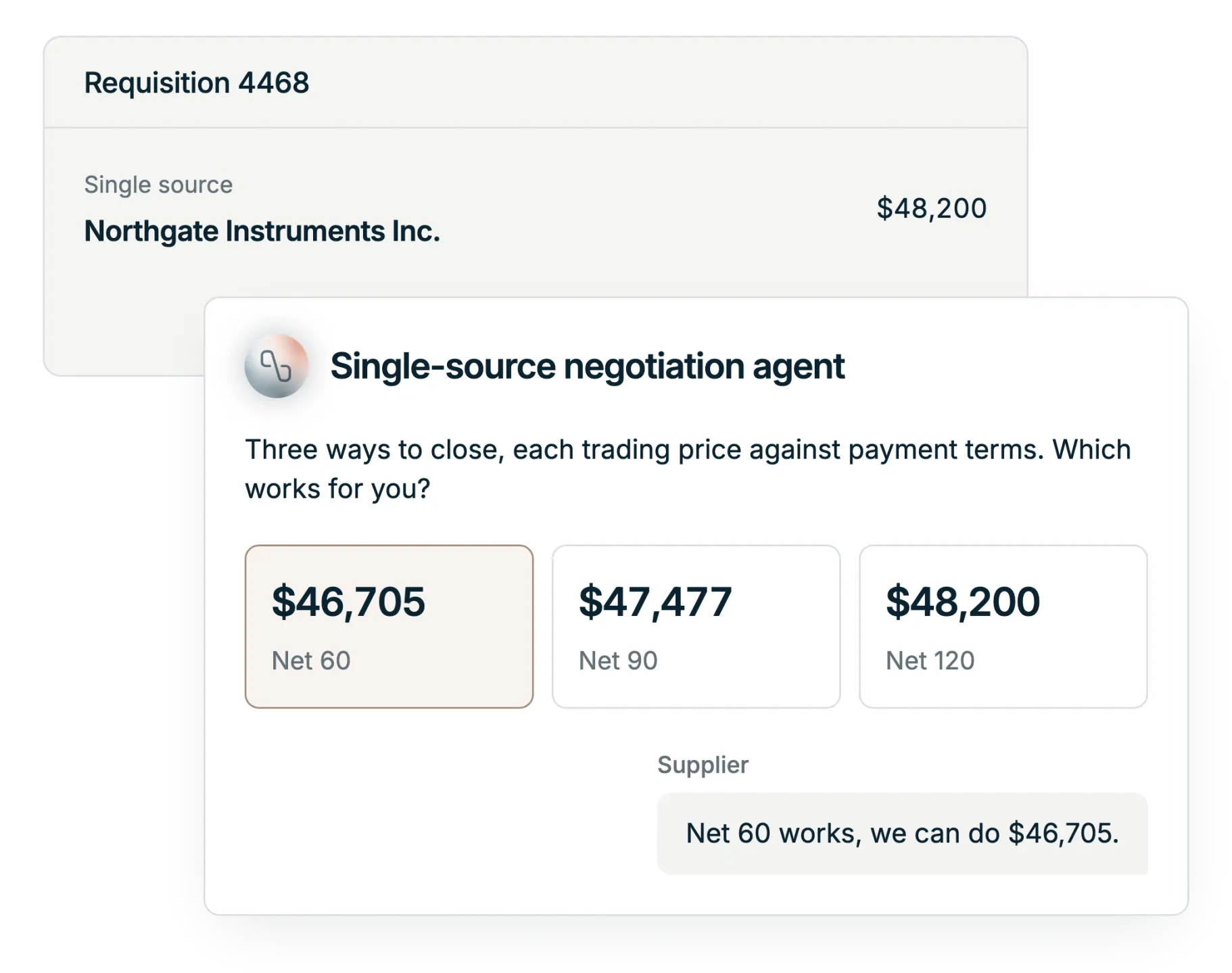
How do you set up autonomous negotiation agents for procurement?
You set the rules once, and the agent handles the rest. Here’s how it works:
The order gets checked
Pactum's Alignment Agent reviews the requisition against your policies, contracts, and approved suppliers in under a minute, and corrects common issues like a wrong code or a missing contract link.
What you get: a clean, compliant request before any negotiation begins.It prepares
The agent reviews the requisition, the distributor's quote, and any existing contract, along with the limits you've set, such as your 60-day payment standard.
What you get: every negotiation starts from your targets, not the supplier's.It confirms the details
Before negotiating, the agent confirms it's speaking to the right contact, that the scope is correct, that nothing has already been delivered, and when the order is needed. If the contact is wrong, it requests the right one and starts again.
What you get: no deals agreed on the wrong order or with the wrong person.It negotiates
The distributor receives an email and a short chat with several equal-value offers to choose from. On average, a negotiation takes about 13 minutes.
What you get: a better deal, with no buyer time spent securing it.It agrees or escalates
Deals within your rules are agreed immediately. Anything outside them goes to a buyer, along with the details needed to make a decision.
What you get: speed on routine deals, and human judgment where it matters.The deal is recorded on the requisition
The agreed terms are written back, and the PO is raised at the negotiated price, in the system finance already uses.
What you get: savings that appear on the PO, with a clear audit trail.
- 13 min
- to complete an autonomous negotiation
- 4.7%
- average saving on the single-source deals it wins
- Up to 70%
- of new savings opportunities result in a saving
Your team sets the strategy, and Pactum’s AI agents negotiate every one-off order, around the clock.
What are the benefits of a single-source negotiation agent?
So how can AI improve supplier negotiations in procurement? By actually having them, every single time. AI doesn’t get tired, doesn’t take a lunch break, and doesn’t let a quote sit in the inbox until Monday.
Plenty of AI tools can help you prepare for a negotiation, but they stop at a recommendation, meaning someone on your team still has to act on the information the AI gave you.
Pactum’s AI agents actually do the work on your behalf. They talk to the supplier, agree the deal, and update the PO, all autonomously.
There are two kinds of AI in procurement right now
AI that helps you work
- Drafts
- Summarizes
- Recommends
You still execute. The capacity constraint stays.
AI that does the work
- Acts
- Negotiates
- Executes
Within your strategy, systems, and security. At a scale no team can match.
Pick a task and see what happens after the answer
A one-supplier quote
AI that helps you work
Flags that the quote could be negotiated.
- BuyerOpens the quote and the contract
- BuyerDecides whether it is worth the time
- BuyerApproves it at the quoted price
Full price, net 30
AI that does the work
Sees room for a better deal.
- AIContacts the distributor
- AIOffers a few equal-value options
- AIWrites the agreed terms to the requisition
Negotiated before the PO
Payment terms off policy
AI that helps you work
Flags 30-day terms against your 60-day standard.
- BuyerEmails the supplier
- BuyerWaits days for a reply
- BuyerLets it through to hit the deadline
Still on 30 days
AI that does the work
Spots the 30-day terms.
- AIPuts your standard terms on the table
- AILets the supplier pick the option that suits them
- AIUpdates the PO
Terms back on policy
A counteroffer
AI that helps you work
Drafts a reply for the buyer.
- BuyerReviews and edits the draft
- BuyerSends it and chases a reply
- BuyerUpdates the requisition by hand
Still waiting on a buyer
AI that does the work
Handles the counteroffer.
- AIAgrees it if it is within your limits
- AIEscalates it with full context if not
- AIRecords the outcome on the requisition
Done, within your rules
One recommends a better deal. The other gets it.
Here’s what procurement teams using Pactum’s AI agents for procurement are seeing
Find the savings you couldn't see
Every business has a list of things nobody negotiates. The off-catalog safety gear, the specialist part only one distributor stocks. Same supplier, same price, year after year.
Well, that list just became your biggest savings opportunity. Pactum’s AI agents go after every single-supplier order, not just the few a buyer can squeeze in.
The supplier is already there, and so is the quote. All that was missing was someone to ask for a better deal. That’s the easiest way to unlock value from unmanaged supplier spend.
And it pays off. On the single-source deals it wins, the agent saves an average of 4.7%. Across global customers, negotiated requisitions have delivered up to 15% savings on spend that used to go straight to PO.
Individually, each saving may look modest. Across hundreds of orders, they add up to a savings line your CFO will notice.
 Customer story · Honeywell$65K saved in one negotiation: How Honeywell saved $65,000 in one negotiation, with no human involvedSee how Honeywell did it
Better payment terms, without the awkward conversation
Every business has a payment terms policy. And every month, a stack of POs quietly ignores it. The safety boots on 30 days, the service renewal on 15, the specialist part on “due on receipt.” Your standard says 60, and nobody pushed back.
Well, that’s cash leaving the business earlier than it needs to, on repeat. Pactum’s AI agents bring your terms into every single-supplier negotiation, not just the few a buyer remembers to raise.
Longer terms or an early payment discount sit right on the table as one of the options. The supplier picks what works for them, and your standard terms stop being a polite suggestion.
And your finance team finally stops asking why the terms never match the policy.
Better deals, and better supplier relationships
Every business has suppliers it barely talks to. The distributor who sends a quote, gets a PO, and never hears from you again. No conversation, no feedback, and no reason to offer anything better.
So can you negotiate while maintaining supplier relationships? Absolutely. In fact, a negotiation is the first real conversation many of them have ever had with you. And if you’re wondering whether AI can really negotiate, Pactum’s AI agents give every single-supplier order that conversation, without a buyer having to pick up the phone.
The supplier picks the deal that suits them, like a small discount or faster delivery. No pressure, no backing them into a corner. And the ones who say yes become your go-to suppliers.
Works right inside Coupa and SAP Ariba
Every business has the message nobody wants to get. “Quick question, why did we pay this price?” Cue three weeks of digging through email threads and trying to remember a phone call nobody wrote down.
So how do you enforce negotiated prices across your supplier base? Make sure the deal never leaves the system. Pactum’s AI agents write every agreed price and term back to the requisition in Coupa or SAP Ariba, so the PO matches the deal, every time.
When finance asks what was agreed, or audit asks why, the answer is already on the order. No spreadsheets, no inbox archaeology, no “let me get back to you on that.”
Your team keeps working exactly the way it does today. The deals just get better.
An army of buyers, without the headcount
Every business has buyers who are stretched too thin. Hundreds of requests a month, a handful of people, and a queue that never really empties. The one-supplier orders are always the first to slip.
So how do you reduce the time your team spends on negotiations? Hand them to an AI agent. Pactum’s AI agents negotiate every single-supplier order, agree within your limits, and only pass a deal to a buyer when it genuinely needs their judgment.
Your buyers stop chasing quotes and start working on the suppliers and sourcing decisions that need their expertise. No new hires, no outsourcing, and no burnout.
And your team finally gets to do the work they were hired for.
Which procurement platforms combine intake with supplier negotiation?
Pactum combines intake and supplier negotiation in one place. This is Autonomous Procurement, taking every request from “I need this” to a negotiated PO, without anyone chasing it.
So what should you look for in a platform that handles intake and supplier negotiations at scale? One that doesn’t stop halfway. Most intake tools give you a friendlier intake form, route the request, and then send it straight back to the buyer’s desk. Nice form, same queue.
Remember the safety boots? With Pactum, the site manager doesn’t need to know a thing about procurement. No forms, no GL codes, no guessing which supplier to use.
They simply type “We need 250 pairs of safety boots and hi-vis jackets for the new site” in Microsoft Teams, Coupa, or SAP Ariba, and Pactum’s AI agents take it from there:
| Step | Pactum’s AI agent | What it does for you |
|---|---|---|
| 1. Request | Intake Agent | Turns “I need this” into a perfect requisition. No forms. |
| 2. Check | Alignment Agent | Catches policy issues before they cost you, and fixes them on the spot. |
| 3a. Negotiate | Single-Source Negotiation | Gets a better deal from the one supplier you have. |
| 3b. Compete | Tactical Sourcing | Brings in rival suppliers, so you get the best offer. |
| 3c. Improve the bids | Post-Sourcing Negotiation | Makes sure the first bid is never the final one. |
| 3d. Run the event | Advanced Sourcing | Runs your biggest sourcing events, start to finish. |
| 4. Order | Pactum’s AI agents | Raises the PO at the negotiated price. Done. |
And all of it runs autonomously, within the guardrails you set. You set the strategy, and Pactum’s autonomous AI workforce carries the procurement work all the way through, solving real procurement problems.
- 11,000+
- autonomous negotiations completed
- $131M+
- in spend processed
- $1.2M+
- saved, starting with requisition negotiations
What controls are needed for autonomous procurement negotiations?
Let’s be honest. The idea of AI negotiating with your suppliers can make even the calmest CPO a little twitchy. What if it agrees to something you’d never sign off on? What if it upsets the supplier you’ve spent ten years keeping happy?
Fair questions. And the answer is, it can’t, unless you let it. You give it the same rules you’d give a new buyer on their first day. Except this new buyer actually follows them, every single time.
So what guardrails should you set for autonomous procurement negotiations? Start with these four:
- Which orders qualify
Decide by value, category, or supplier. Routine orders in, complex deals out, or whatever mix suits your business.
- Your limits
Set the walk-away price, the payment terms you'll accept, and your approved suppliers. The agent never goes past them. Not even on a Friday afternoon.
- Who's off-limits
Your strategic suppliers stay with your buyers, so you can negotiate at scale while maintaining the supplier relationships that matter most.
- How much freedom it gets
One setting takes it from advisory, where a buyer has the final say, to fully autonomous. Change it whenever you like.
Looking to implement autonomous procurement negotiations in your organization? You don’t have to go all in on day one. Start in advisory mode, and give the agent more room once you trust its calls.
And because Pactum works inside Coupa and SAP Ariba, setting up autonomous negotiation agents doesn’t turn into a months-long ERP project. It runs on your rules, in your systems, and you make the call.
Free eBookWhat is Autonomous Procurement?How AI agents run the buying process end to end, within the strategy and guardrails procurement sets.Read the eBook