See how Pactum's AI agents for procurement negotiate with every bidder after your RFQ closes. More savings, more time back, and no more awarding on round one.
Why do buyers award the lowest bid and move on?
It’s late October, and your category manager has spent three weeks on the snow clearing RFQ for 30 sites across the Northeast. They’ve written the scope, answered supplier questions, chased the suppliers who hadn’t replied and lined up four bids in Coupa.
The lowest comes in at $182,000. The runner-up is at $189,000, but it’s the supplier your site managers actually trust to show up at 5am. Facilities is pinging every other day, because the first snowfall is close and nobody wants to explain an icy parking lot.
Round one. Lowest bid. Award. Done.
And somewhere in that comparison, the runner-up was ready to go lower, but nobody asked.
So why do buyers award the lowest bid and move on? Because they simply did not have the time to re-negotiate. Every buyer knows round one is rarely a supplier’s best offer, but going back to every supplier is a whole second sourcing event that your team does not have the capacity for.
And if someone does decide to run a second round? Congratulations, they’ve just signed up for another week of this:
Decide who's worth going back to
Which bids are close enough, and which suppliers can actually cover all 30 sites?
Set a target for each supplier
On price, payment terms and lead time, not just the headline number.
Write to every supplier without giving anything away
Push each one to improve without revealing anyone else's price, carefully.
Wait, chase, and wait again
Round two gets the same slow replies as round one, just with less patience on your side.
Handle the counteroffers
"We can drop the price if you move to net 15." And now you're comparing apples with oranges again.
Rebuild the comparison
Every new offer means lining up price, terms and lead time all over again.
Explain the award
To facilities, who wanted it signed last week. To audit, who want to know why the leader changed.
Update the event
Back in Coupa or SAP Ariba, if the award is even made there.
Now multiply that by every sourcing event your team closes this quarter. No wonder round one usually gets the final word.
How much money is left on the table after an RFQ closes?
More than anyone would like to admit. In 58% of closed sourcing events, suppliers still had a further saving to give, and the bids that moved came down 8% on average. And in 31% of events, the supplier leading after round one wasn’t the best final offer.
Read that again. About a third of the time, the bid you were about to award was the wrong one.
Nobody leaves that money on the table on purpose. It just slips away in the same few ways, event after event:
- The lowest bid wins by default
Comparing prices takes a minute, but comparing service, terms and lead time takes the afternoon nobody has.
- The business wants the award now
For your stakeholders, the RFQ closing means it's done. For procurement, that's exactly when you have the most leverage.
- Suppliers know nobody comes back
So round one is their opening offer, not their best one. Yes, the very thing a best and final round was invented to fix.
- Second rounds only happen on the big events
The headline contracts get a best and final round. Everything else gets round one and a thank-you email.
- The cheapest bid isn't always the right one
Especially for services. Nobody gets praised for cheap snow clearing that turns up after the car park has frozen.
- Your buyers are already at capacity
They're onboarding new systems, fighting supply issues and clearing the queue. A second round on every event? With what time?
Your buyers know exactly how to run a best and final round. What they don't have is another week for every event that closes.
So what if every bid got a second round, and your buyer only had to pick the winner?
What is a Post-Sourcing Negotiation agent?
Pactum’s Post-Sourcing Negotiation Agent is an AI agent that negotiates a final offer with every shortlisted supplier after an RFQ or RFP closes, and before you award. It negotiates price, payment terms and lead time over several rounds, then brings the final offers back side by side so your buyer can make the call.
Think of the buyer who goes back to every supplier after the RFQ closes and asks, “Is that really your best offer?” Now imagine that the buyer could ask all of them at once, never give away anyone else’s price, and never run out of time. Pactum’s AI agent for procurement does exactly that.
And there’s nothing new to roll out. Pactum’s AI agents for procurement integrate with Coupa and SAP Ariba, right where your sourcing events already happen, so there’s no IT ticket, no six-month project, no “we’ll look at it next quarter.”
| The manual way | Pactum’s AI agents | |
|---|---|---|
| Who wins | Whoever bid lowest first | Whoever makes the best final offer, and in 31% of events that’s someone else |
| What you pay | The supplier’s opening price | Their best price, with bids that move coming down 8% on average |
| Payment terms | Whatever they put in the bid. Net 30, probably. | Negotiated with every supplier, on every event |
| Who does the negotiating | Your buyer, one email at a time, if they have a spare week | AI agents, autonomously, with every supplier at once, within the targets you set |
| Your team’s time | A week per event | Pick the shortlist, make the award, done |
| Your suppliers | Most never hear back | Every one gets a fair shot at winning, without seeing anyone else’s bid |
| The deadline | Met, at round-one prices | Met, with final offers back within days |
Your team sets the strategy and the guardrails, from the targets to which suppliers get a second round. Your buyer makes the final call, and your AI workforce does everything in between.
Get the best final offer on every eventSee how AI negotiates with every bidder after your RFQ closes.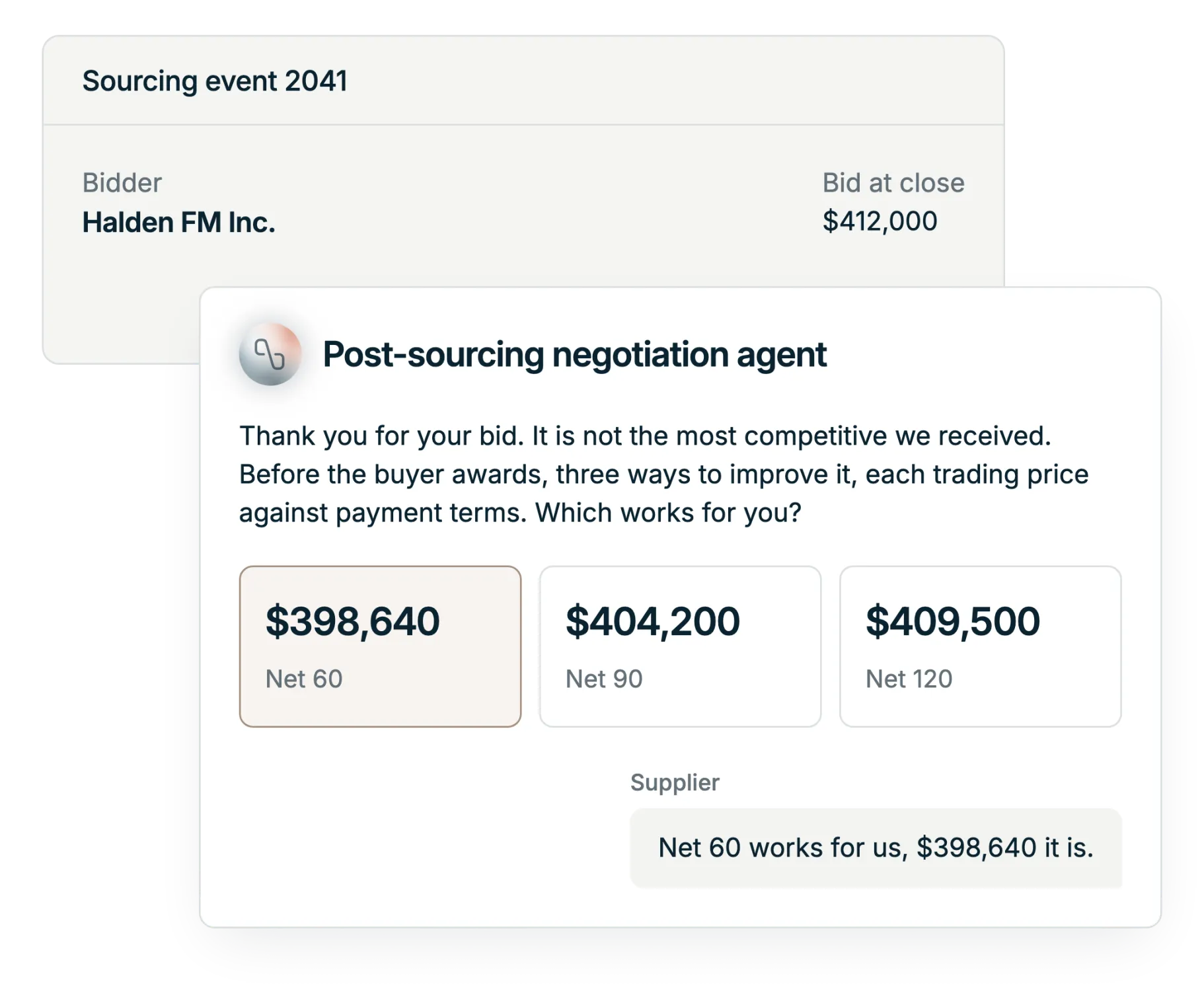
How does post-sourcing negotiation work?
Here’s how the snow clearing event plays out when Pactum’s agent runs round two:
How it works
From round one to the best final offer
Close
The RFQ closes with every bid in.
Shortlist
Your buyer picks bidders and targets.
Negotiate
Every bidder, at the same time.
Compete
Each on their own offer.
Compare
Final offers, side by side.
Award
Your buyer makes the call.
The event closes
The RFQ closes in Coupa with four bids, and your category manager switches on the Post-Sourcing Negotiation Agent right there on the event. On SAP Ariba or another sourcing tool, they drop in the bids as a file and the agent matches up the line items for all 30 sites.
What you get: a second round on the event you already ran, with no new integration project.Your buyer picks the shortlist and sets targets
So how do you decide which suppliers are worth negotiating with? Round one has already told you. Your category manager looks at who came in close, who can actually cover 30 sites, and where the gaps are. Then they pick the bidders and set targets on price, payment terms and lead time.
What you get: a negotiation that follows your strategy and your guardrails, set up in minutes.The agent negotiates with every bidder
All four snow clearing suppliers hear from the agent at the same time. It runs a structured negotiation with each one on price, payment terms and lead time (here, how fast the crews turn up after a snowfall), autonomously and in the background.
What you get: every supplier asked, without adding a single task to your buyer's day.Every supplier competes on their own offer
Suppliers never see each other's bids. Each one only sees how competitive its own offer is, so it knows whether to move, and nobody's numbers get shared.
What you get: real competition, with every supplier's pricing kept private.Final offers come back side by side
Within days, the results land back on the event. Every supplier's final offer sits side by side, with the total amount, payment terms, savings against the original bids and how each line item improved, plus the full transcript of every negotiation. The runner-up has come down 8% to $173,900 and moved to net 60, so it's now in the lead. Exactly the kind of switch that happens in 31% of events.
What you get: the best final offer and the savings in plain numbers, without holding up the award.Your buyer makes the award
Pactum presents its recommendation, but the final decision always stays with your team. Your category manager confirms the winner with every transcript in front of them, and facilities gets its contract before the first snowfall.
What you get: a better deal, a human decision, and an award that's easy to defend.
Your buyer makes one decision. Your AI workforce handles the week of work that used to come before it.
What are the benefits of post-sourcing supplier negotiations?
The next snow clearing event closes, and this time nobody reaches for the lowest bid.
While your category manager gets on with their day, Pactum’s AI agents go back to all four suppliers. The runner-up comes down on price, the incumbent finds better terms, and by the end of the week the final offers are lined up and ready.
Your category manager awards on the final round, not the first one, and the contract is signed before the first snowfall.
That’s a week of work your team would never have had time for. Now your AI workforce does it on every event that closes. Here’s what changes for procurement teams using Pactum autonomous AI agents:
Find the savings hiding in bids you already have
The hardest part of any sourcing event is done before round two even starts. The scope is written, the suppliers are qualified and the bids are in. Stopping there means walking away from the easiest savings of the whole event.
So how do you measure the ROI of a second round? Compare the final award with the round-one award you were about to make. The difference is savings on spend you’d already sourced, and it shows up event after event:
- 58%
- of closed events give up a further saving
- 8%
- average saving on the bids that moved
- 31%
- of events end with a different leader than round one
Those are savings your team was never going to chase, because nobody had a spare week. Now they land on every event, and not one “can you do better?” email leaves anyone’s outbox.
Award the best final offer, not the best first one
Every buyer knows the lowest bid isn’t always the best one. Price matters, but so do service, reliability and how fast someone picks up the phone when things go wrong.
The trouble is, round one makes that trade-off harder than it needs to be. The supplier you trust is often a little more expensive, and without a second round, you’re stuck choosing between quality and price.
Pactum’s AI agents negotiate price, payment terms and lead time with every bidder, so the supplier you’d rather work with gets a real chance to close the gap. And it happens more than you’d think. In 31% of events, the round-one leader isn’t the best final offer.
The cheapest first offer and the best final offer are often two different suppliers. Your buyer awards on the full picture, and your AI workforce makes sure the picture is complete.
Better payment terms on every award, not just the big ones
Payment terms are the quiet part of every sourcing event. Everyone watches the price, and terms default to whatever the supplier put in their bid.
Can AI agents negotiate better payment terms than humans? They certainly ask more often. Pactum’s agent puts terms on the table in every negotiation, with every supplier, on every event, alongside price and lead time. Not just on the headline contracts where someone remembers to bring them up.
In the snow clearing event, net 30 becomes net 60. A small change on one contract. Across every event your team closes in a year, it adds up to real working capital.
Finally, a sourcing event that ends with finance asking how you did it, not why the terms slipped again. Better terms on every award, and not a single extra line on your buyers’ to-do list.
Negotiate harder without damaging the relationship
Here’s the worry every buyer has about a second round. Push too hard and you sour a relationship you’ll need all winter. Go back to a supplier who thought they’d won, and things get awkward fast.
So can you negotiate contracts while maintaining supplier relationships? Yes, when the process is fair and the same for everyone. Every supplier gets the same clear rounds and the same chance to improve. Nobody sees anyone else’s bid, and each supplier only sees how competitive its own offer is. No games, no leaked numbers, no “well, your competitor said…”.
And suppliers don’t mind a second round with AI. In fact, 85% of suppliers would rather negotiate with AI than with a human buyer. They get quick answers, a clear process and a real shot at winning, instead of three weeks of silence followed by a rejection email.
Every negotiation also comes with a full transcript. So when audit asks why the award went to the runner-up, the answer is already on file.
Tougher on price, easier on the relationship. Your buyers keep the relationships, and your AI workforce has the tough conversations, fairly, every time.
A second round on every event, without adding headcount
Right now, a best and final round depends on who has time this week. The big contracts get one. The rest get round one and a thank-you email.
Looking for procurement platforms that negotiate with multiple suppliers simultaneously? Pactum’s agent negotiates with every bidder, on every event, at the same time. Strategic suppliers, the ones in between and the ones you barely know all get the same second round. Every RFx gets one, not only the events a buyer could carry.
So your team spends less time on negotiation emails, and more on the work only people can do, like building supplier relationships, shaping category strategy and making the calls that need judgement.
More events negotiated, same team. Your AI workforce does the work you never had time for.
What is a best and final offer (BAFO) in procurement?
A best and final offer, or BAFO, is the last round of a sourcing event. Once the first bids are in, shortlisted suppliers are asked to improve their offer one final time before the award.
Every procurement team knows it works. The problem is it takes a week of emails, so it gets saved for the biggest contracts. Pactum’s AI agents make BAFO the default on every event:
| BAFO by email | BAFO with Pactum’s AI agents | |
|---|---|---|
| Which events get one | The big ones, when someone has time | Every event, big or small |
| Who runs it | A buyer, squeezed in between ten other things | AI agents, autonomously, in the background |
| Same rules for every supplier? | Depends who’s writing the email that day | Yes, one fair process for every supplier |
| Keeping prices private | One forwarded email away from a leak | Suppliers only see how competitive their own offer is |
| Line-item detail | Lost somewhere in the spreadsheet | Every line item and how it improved, side by side |
| Savings reporting | Worked out by hand, if finance asks | Savings against the original bids, right on the event |
| What audit sees | Scattered email threads | A full transcript for every supplier |
The crews still turn up before the first snowfall. The contract just costs less, on better terms.
From intake to PO, with the best price at every step
The snow clearing event is just one part of the picture. So which procurement platforms combine intake with supplier negotiation? Pactum does, from the very first request all the way to the PO.
Everyday requests run autonomously from intake to PO in under a day. Bigger purchases go through a sourcing event, and now every one of those ends on the best final offer, not the first one. Either way, Pactum’s AI agents do the work, and nobody on your team chases a single email.
Autonomous Procurement
From intake to PO, at the best price
Here’s how each AI agent plays its part:
| Step | Pactum’s AI agent | What it does for you |
|---|---|---|
| Ask | Intake Agent | Turns “we need 200 bags of grit salt for the Boston site” into a complete request. No forms, no GL codes. |
| Check | Alignment Agent | Checks every request against your policies in under a minute, and fixes common issues on the spot. |
| Negotiate | Single-Source Negotiation Agent | Gets a better deal when there’s only one supplier on the order. |
| Compete | Tactical Sourcing Agent | Brings in more suppliers when there’s only one quote, and negotiates with all of them. |
| Source | Advanced Sourcing Agent | Supports your bigger, more complex sourcing events. |
| Close | Post-Sourcing Negotiation Agent | Goes back to every bidder after the event closes, so you never award on round one again. |
| Order | Pactum’s AI agents | Raise the PO at the negotiated price. Done. |
Your team sets the strategy and the guardrails. Your autonomous AI workforce takes every request from “we need this” to “signed, and for less.”