From Insight to Execution
What changes when AI stops advising procurement and starts negotiating with suppliers?
- Speakers
- Sean Sieper & Jim Rahill
- Event
- DPW New York 2026
- Runtime
- 90 seconds
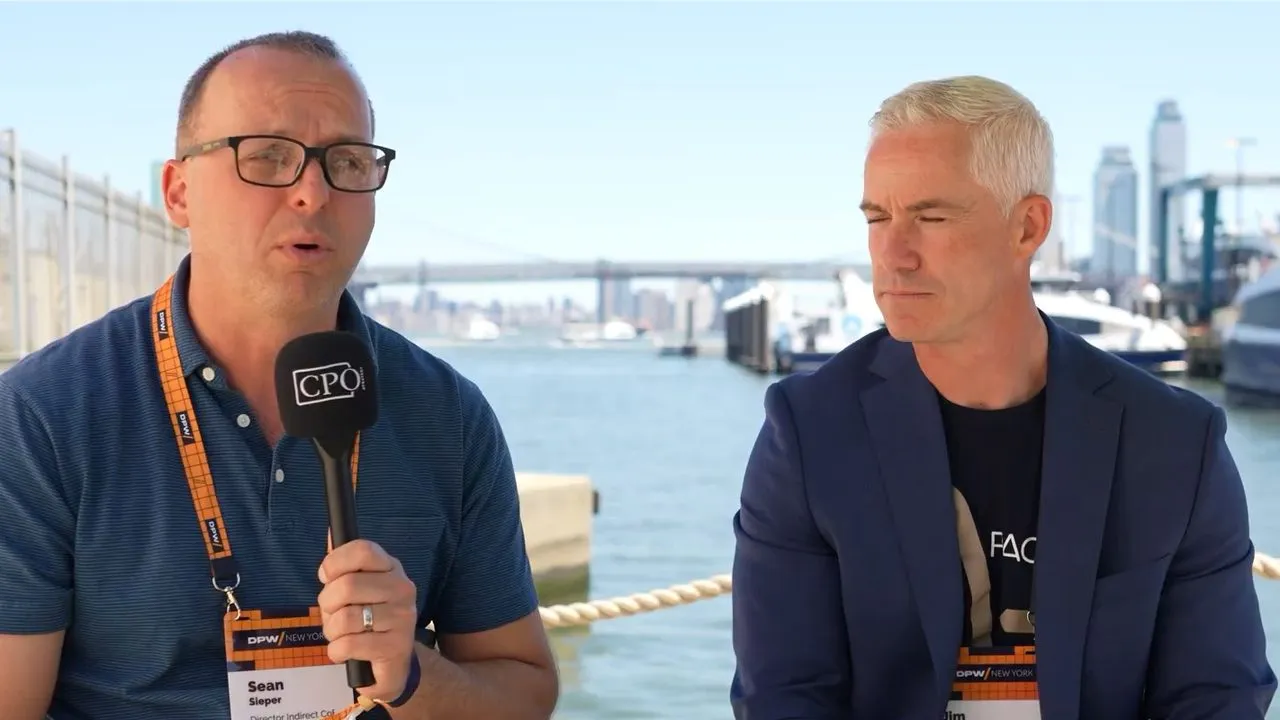
Ahold Delhaize USA has started to let AI agents negotiate with select suppliers. At DPW New York, Sean Sieper, Director of its Indirect Center of Excellence, and Jim Rahill, Global Vice President of Sales at Pactum, talked about the first months.
Insight is only the first step
Most AI tools in procurement stop at advice. An agent has to do the work.
Many procurement teams already use AI to surface insights. The tools give analysis, and summaries of what the business could do better. Then they stop. Someone still has to go to the supplier and get the deal done.
“The technology is advanced enough where it can take a data set and provide analysis or insights,” Jim told CPOstrategy. “But when you involve a third party, such as a supplier in our case, that agent has to go out and do the work within the defined guardrails. Then they must bring it back and update their source systems.”
That is the work Pactum now does for the Indirect Center of Excellence at Ahold Delhaize USA. Digital workers negotiate with select suppliers, with the goal of cost savings. “We’re a couple of months into the relationship, and we’ve had great results so far,” Jim says.
For Sean, it is a step from trying AI to using it: “This is about moving to practical application in a controlled environment within our team, with strong governance built in from the start.”
- Step 1Data
Spend and supplier data - Step 2Insight
Analysis and summaries of what you could do - Step 3Negotiate
With the supplier, inside the guardrails - Step 4Agree
The deal, on behalf of the team - Step 5Update
The source systems
More capacity, not only speed
For Sean, the value of agents is capacity.
Generative AI helps people do a task faster. An agent takes a defined piece of work off the team completely. Every buy deserves a negotiation, but a team never has the time to run them all. The routine negotiations can go to the agent.
“The real opportunity is helping our team scale routine activity so our associates can stay focused on strategic supplier relationships and higher-value work,” Sean says.
The scale comes with rules. “It is all about working with Pactum and putting in our guardrails for what we would expect from the negotiation, and then doing that at scale,” Sean says.
Guardrails first
The customer sets the rules. The agent negotiates inside them.
An agent that talks to suppliers works within the rules and commercial boundaries the customer sets. It also has to keep the supplier relationship in good shape, and many suppliers like negotiating with an agent.
“Our supplier relationships are extremely important to us, and critical to our business,” Sean says. “Transparency into how decisions are made is essential. It helps build confidence with stakeholders by making the process visible and understandable.”
For many stakeholders, this is the first time they see an AI agent at work. They can follow the real back and forth with the supplier and see how the agent answers.
People still review every negotiation. “Today, we maintain full oversight of each negotiation and interaction,” Sean says. “Over time, as confidence builds and governance matures, the level of review can evolve appropriately.”
Pactum recommended starting this way. “It is a comfort level the client has to achieve before they reduce the amount of human engagement,” Jim says. Full review at the start proves that the agent can work at scale.
Value in weeks, not months
Procurement teams have to show results, and they have to show them fast.
“We have cost, capacity and external considerations,” Sean says. “There’s a clear expectation to demonstrate measurable value, while ensuring we implement these capabilities responsibly and protect our supplier relationships.”
Jim hears the same pressure across the market. “It is no longer acceptable for it to take six months to implement and another six months for an ROI to be achieved,” he says.
Implement, then ROI
12 months
Agentic AI
Weeks
ImplementWait for ROIValue
So Pactum starts with one question: which suppliers, categories and opportunities give value fastest. At Ahold Delhaize USA that means starting slowly, building confidence, then going further as the team gets more comfortable.
Both of them are careful not to oversell. Sean says the function still has “a long way to go”, with investment barriers, pricing structures and governance questions still open. Jim does not expect agentic AI to replace traditional enterprise software any time soon.
The goal is clear for both: put agents where they deliver real results, build trust through governance, and move procurement from insight to execution. See how Pactum digital workers buy and negotiate across indirect spend.
“When you see that completion, that the AI agent actually went out and did something versus just surfacing an insight, that is where the magic happens.”
Jim Rahill, Pactum
From request to negotiated deal, run by digital workers.
Every request checked against your policy, then sourced and negotiated inside your guardrails, with a full audit trail.