AI Agents as the New Talent Stack
What happens when hiring starts to include onboarding AI agents?
- Speaker
- Kristjan Korjus
- Stage
- TechChill
- Runtime
- 18 minutes
Kristjan Korjus has spent his whole career building things that think for themselves.
His first program was a chess engine, built in high school so he could play against it. He studied mathematics at the University of Manchester, then came home to the University of Tartu for a PhD in computer science and AI.
There he found a small preprint from a tiny team: a system that learned to play any computer game at a superhuman level. To him it felt like general intelligence. With five others he spent a year rebuilding it as open source, and it worked. Then Google bought the team behind the paper for half a billion dollars. It was DeepMind.
Next came Starship Technologies, where he led the work on the brain of the self-driving delivery robots: seeing people, traffic lights and sidewalks. Six or seven years ago he co-founded Pactum.
“For a couple of days, I became the biggest expert of DeepMind in the world.”
The fourth phase
Software has moved through phases. First the deep core of the mainframe era, then the internet era, then SaaS. Now comes a fourth: software that does the work itself.
Kristjan used procurement as the example, but the picture holds for most industries. The first phase is ancient and critical, the core where an enterprise keeps its most important historical data. The second came with the internet: proper systems you could log in to. The third is the SaaS boom, thousands of tools that are each good at one niche task.
The fourth phase is not more software. It is AI agents. They collaborate with you, go off to do a task, make decisions with the authority they have been given, and come back. Virtual colleagues working inside your software and your business.
01The coreMainframe era records
02Internet era systemsLog in and do it yourself
03The SaaS boomThousands of niche tools
04AI agentsDo the work, then report back
How long a task AI can take on
Seconds →hours
And AI keeps getting better. Kristjan's favourite way to measure it comes from metr.org: how long a task can you hand to AI? Six years ago, language models could autocomplete and run simple queries, work that takes a human seconds. A couple of years ago they could search the web and do ten minute tasks.
Late last year something changed in programming. You can now give the machine a five or ten hour task and it comes back with the right answer about half the time. The same is starting to happen in marketing, writing, design, strategy and answering email.
Pactum already went past programmers. Every employee has an AI agent as a coworker, connected to Slack, Google Drive, Jira, the data warehouse and every meeting note. It goes off, finds what it needs and comes back with slides, documents or posts.
“The revolution is just happening.”
Agents for procurement
An agent has no screen to point at, so in the early days Kristjan explained Pactum by playing the robot himself.
In its second month, Pactum met senior Walmart executives in Viljandi, a small town in Estonia. They had flown in to see a different company. Pactum was invited to pitch, and the pitch was simple.
Walmart had around 500,000 suppliers. Someone has to answer their price increase requests, find new ones and keep them all in hand, and nobody has the time. Let the agents take the 80 percent that matter least, and keep the people on the 20 percent that matter most. Because nobody was dealing with those suppliers anyway, the agents did not even need to be better than humans. They just needed to do it.
Walmart became the first customer. Six years on, more than 60 large global enterprises use Pactum, the company has 160 people, and last summer it raised a 54 million dollar Series C.
The work itself is the kind everyone recognises. The supplier email bounces, so you search for a new one. The price is too high, so you find two more suppliers. Then you learn you need the delivery a week earlier, so you go back to all of them. That is the job of buying for a large enterprise, and that is what the agents automate.
Two ideas
Kristjan closed with two ideas he is excited about right now. Both are about how to live and work with agents, not how to build them.
Idea one
Explainable AI is a dead end.
Especially in the EU, people ask for AI that can explain its thinking. There are even university courses on it. Kristjan thinks it is the wrong way to look at the problem. We do not open a person's brain and measure neurons to understand a decision. Ask an agent why it made a mistake and the answer is either a lie or a misunderstanding. And it gets harder as agents spin up thousands of sub-agents.
What works is observability and guardrails. Log every tool an agent uses, from sending an email to touching a system, so you can see later what happened and decide whether you like it. Analyse it automatically, block access to what agents should not touch, and pass the hard cases to a person.
Every action logged. Blocked actions in outline.
Idea two
Deploying agents is like hiring people.
Rolling out software means user testing and efficiency metrics. Putting agents to work looks far more like onboarding a new hire.
- 01Write the job description
- 02Share the company policies
- 03Re-read them when policies change
- 04Weekly checks in the beginning
- 05Quarterly performance review
- 06Annual review
- 07Change the job, or let them go
- 08Exit interview
“If you put them in the wrong place, their effect is extremely limited.”
Kristjan Korjus, TechChill 2026
Where you place them matters just as much. Hire a couple of brilliant people into a huge company, put them in the wrong place with the wrong tasks and the wrong data access, and their impact is close to nothing. The same goes for agents in an organisation of hundreds of thousands.
It only really started late last year, when programmers began handing whole tasks to agents. Now it is spreading everywhere.
A major revolution for humankind.
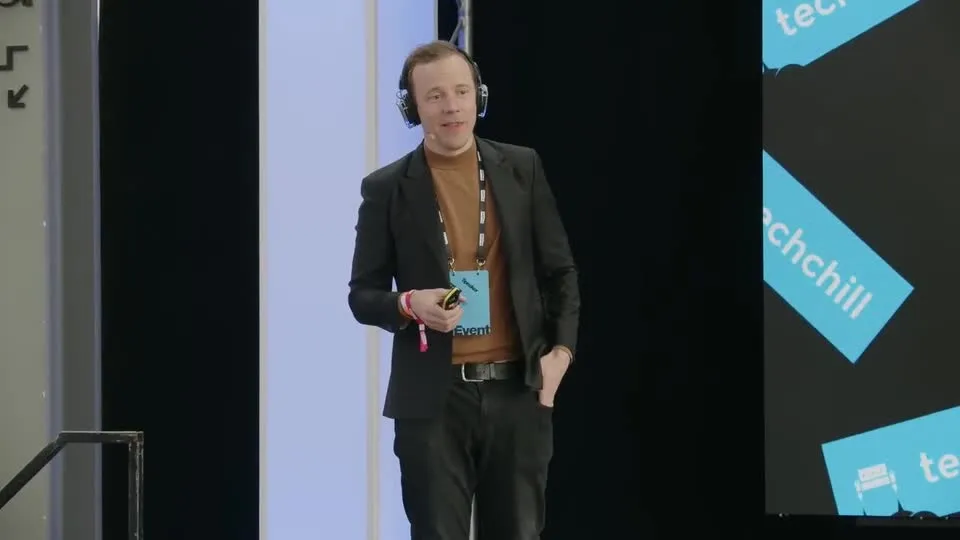 Full talk · 18 minutesWatch Kristjan on the TechChill stageWatch on YouTube ↗