AI Agents Eating Software
What does a day at enterprise HQ look like when the agent does the work?
- Speakers
- Kaspar & Kristjan Korjus
- Stage
- Latitude59
- Runtime
- 11 minutes
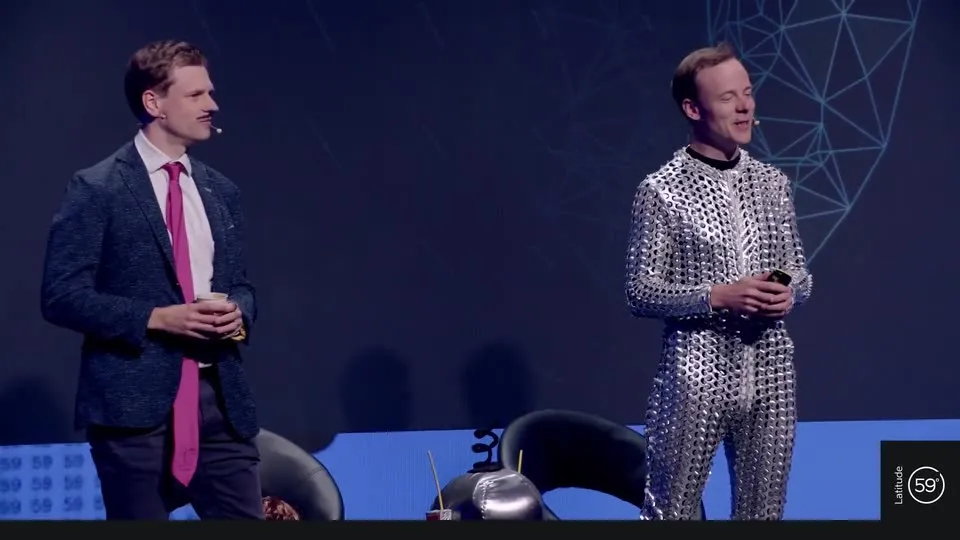
Latitude59, Tallinn, 2025. Two founders walk on stage in costume.
The screen sets the scene: you are about to see what another day at enterprise HQ looks like. Kaspar Korjus walks on as the boss. His name is Tommy, he runs a truck manufacturer, and he wears a long wig, a pink tie and a coffee in his hand.
Kristjan Korjus follows as the procurement AI agent, in a silver suit and a robot helmet. Its job is to analyze data, spot opportunities and negotiate with suppliers to save the company money. It works for the boss.
The boss and the agent
The agent has been busy and the boss does not read emails these days.
Steel prices are falling. The agent downloaded fresh commodity data, analyzed the company’s history, its competitors and the trends ahead, and spotted an opportunity to negotiate. It sent the boss an email about it. He had not read it.
The plan is simple. Suppliers raise their prices when commodities climb, so they can bring them down when commodities fall. The agent wrote out its arguments, including a version anyone can follow, and proposed to go all in. The boss gave his approval.
Steel price dropTruck Manufacturing Inc.
- Downloaded commodity data for steel, alloys and energyPactum Agent
- Found a negotiation opportunityPactum Agent
- Email sent to the bossPactum Agent
- Negotiation approvedTommy, the boss
- Wrote the negotiation argumentsPactum Agent
- I’m making an anchor offerPactum Agent
- The supplier countered some argumentsSupplier
- We met in the middle: €161,000 savedPactum Agent
- Supplier left feedback: pleased with the dealSupplier
- 11,234 negotiations approvedTommy, the boss
While the boss sits back with his espresso macchiato, the agent returns. 161,000 euros of pure profit. It was a tough negotiation: the supplier agreed with some arguments and not with others, they met in the middle, and the supplier was pleased with the deal too.
Then the boss asks the obvious question. How many suppliers are affected by the steel price? 11,234. Can you go to all of them now? Of course. The agent only needs one approval.
One agent
Suppliers on steel11,234
“11,000 negotiations approved.” “Consider it done.”
Not a future state
Kaspar is the co-founder and CEO of Pactum. Kristjan is co-founder and chief scientist. Yes, they are brothers, and Kristjan is the older one.
What the room had just seen, Kaspar said, was no futuristic state. It is what was already happening. More than 50 global enterprises had deployed Pactum’s agents, so that bosses can be bosses and agents do the work. The boss only got emails. The AI was working.
To show how we got here, Kristjan went back to 2011, when Marc Andreessen wrote that software is eating the world. It is part of the reason for Estonia’s success. Every industry was reshaped by software, and a lot of great software was built over two decades.
About a decade ago, AI started to think. Nvidia’s Jensen Huang said AI is going to eat software, and ChatGPT showed everyone that machines can now reason a bit and reply. The next step is to put that intelligence to work: give agents data, autonomy and authority to do the work of people, instead of being software for people.
- 2011
Software is eating the world
Marc Andreessen - 2017
AI is going to eat software
Jensen Huang - 2025
Enterprises run by agents
The Korjus brothers
“Enterprises are now run by AI agents.”
Built for agents
Pactum started where no software was doing the work: the negotiation.
Kaspar laid out the procurement software of a large enterprise. At the bottom sits the data layer, usually the ERP. Above it, the transaction layer. And over the last two decades, four to five hundred software startups that follow the buying journey, from someone wanting to buy something to the negotiation and the contract.
Six years earlier, Pactum went after the negotiation, because no software did it. The difference was who it was built for: not people, but agents, so they could do the work on their own. Next, agents will move into every other step, from the first request to the payment. Procurement teams will change, and much of the software built today will be redundant within a decade.
- 01IntakeSomeone wants to buy something
- 02SourcingFind the suppliers
- 03NegotiationWhere Pactum started
- 04ContractingAgree the terms
- 05PaymentPay the supplier
A call to action
Build software for agents, not for people.
The brothers closed with a request to everyone in the room. Founders: instead of talking to the users of software and building software for them, build the agents that do the work. Investors: give those founders money. And to leaders, team leads and company owners, one more thought.
“When you are planning to hire the next ten, hundred or thousand employees, maybe you could buy some agents instead.”
Kaspar and Kristjan Korjus, Latitude59 2025
Agents do the work. You lead.
 Full talk · 11 minutesWatch the brothers on the Latitude59 stageWatch on YouTube ↗
Indirect spend, finally under control
See how agents like the one on the Latitude59 stage check, decide, source and negotiate every indirect request, end to end.