By Pactum · · 15 min read
It was exactly five years ago that the world first learned about autonomous negotiations as an emerging field of AI.
Well, if you happened to be in the Facebook group where soon-to-be Pactum cofounder Kaspar Korjus first posted about the concept – with little fanfare and quite mixed responses.
Rewind.
It’s 2019 and AI is far from the buzzword it is today. Back then, crypto and the metaverse used to be the future, while few people had experienced a useful chatbot.
“You have always been a helpful group,” Kaspar posted to the ‘e-residents of Estonia’ Facebook group in April 2019 while looking for feedback on the idea that would shortly become Pactum AI.
The e-resident community was the result of Kaspar’s first big idea to unlock value globally. Kaspar had founded the Estonian government’s e-Residency program to give non-Estonians access to the country’s digital business environment.
Few understood the concept at first, but e-Residency helped democratize access to entrepreneurship around the world, while boosting Estonia’s economy, bringing in many millions in state revenues, and enhancing the country’s reputation for innovation. During this period, Kaspar became the most quoted Estonian in the international media, even ahead of the President and the Prime Minister.
After Kaspar stepped down from the e-Residency program at the start of 2019, many in the e-resident community were eager to hear what big idea he was working on next.
“I am going to build an AI negotiation tool for business,” he posted in their group. “Most of the business world today depends on negotiations, whether it’s HR offices for hiring processes, procurement offices for buying products or a startup in logistics that has car dealers in different countries. Do you have negotiations going on in your business or some thoughts where an AI for you could add a lot of value?”
The community was incredibly supportive, but it’s fair to say not everyone was exactly blown away.
“No robot can do that,” one person responded, “BUT you can help workers improve their negotiation skills.”
The responses were similar offline. Even Kaspar’s own father, always very supportive, gently advised Kaspar that perhaps this might not be the best path.
“I’ve got to be honest with you,” he said. “I don’t think AI negotiation is a thing.”
Kaspar wasn’t the only talent in the family intrigued by this topic though. His brother, Kristjan Korjus, happened to be a best-selling mathematics author in Estonia and a world-leading expert in Artificial Intelligence (before that kind of title earned much interest). He has written a range of academic papers on the topic. The AI community took notice of Kristjan when he led the first project to successfully replicate DeepMind’s AI.
While Kaspar was at e-Residency, Kristjan was Head of AI at Starship Technologies, the leader in autonomous delivery robots. If you encounter a six wheeled robot carefully weaving its way through pedestrians and traffic – whether in California or Estonia or countless places in between – then it’s Kristjan’s AI inside.
Five years ago, Kristjan and Kaspar were the right people at the right time to start developing AI to unlock global value, long before the world would properly wake up to its game changing capabilities. They just needed a problem to solve.
Enter Martin Rand.
To understand the path that Pactum’s cofounders took in developing their AI, we need to rewind the story a little further.
Martin was a former colleague of Kaspar’s who had begun his startup career as a product manager for a once small Estonian startup called Skype. Needless to say, it became a global hit. For Estonia, which was undergoing rapid reforms to be a tech-savvy, business-friendly nation, the success of Skype was akin to having a prestigious international business school suddenly pop in the country.
Skype nurtured a generation of innovators in Estonia with the ambition and capital to build bigger ideas, while inspiring their peers. This influence was compounded when its alumni created yet more globally successful companies, like Bolt and Wise. Just as the ‘PayPal mafia’ rose to prominence in Silicon Valley, the ‘Skype mafia’ emerged to define the Silicon Valley of Europe.
Martin founded his own startup after Skype too, which was then acquired by Monsanto where he ended up as Commercial Lead for Europe at The Climate Corporation owned by Monsanto.
In this role, Martin was now negotiating multi-million dollar deals on behalf of a Fortune 500 company. Then, in 2017, Martin began the negotiation that led to thousands of autonomous negotiations. Actually, it was a negotiation that never quite got started.
He was negotiating with a potentially big deal with a conglomerate whose representatives immediately laid down their non-negotiable terms. Martin knew what they were asking was impossible. He told them that and they abruptly walked away.
Afterwards, Martin kept replaying the negotiation in his head. It could have gone so many different ways, but he knew there must have been a path to a mutually beneficial deal. He didn’t blame the other side. Even after those red lines were laid down, he could have responded differently.
The first problem, he realized, is that large enterprises rely on managers to negotiate even though they have never been given any kind of negotiation training. They’re playing the role of negotiator based on untested assumptions, influenced by caricatures of negotiators playing hardball to win at the expense of the other side.
Determined to make amends for that lost opportunity, Martin began exploring the art of negotiation.
He studied at Harvard to learn Harvard’s principles of negotiation. He even took a course with the FBI’s former top negotiator. He didn’t just learn to be a good negotiator. He learned to see negotiations differently. He came to understand that negotiation is value creation. It’s not a zero-sum game, as too commonly depicted. It’s enhancing relationships by figuring out how to offer more value to each other.
That’s why trained negotiators prefer to negotiate with other trained negotiators. Their negotiations look more like a brainstorm in which they figure out how to offer each other as much value as possible. In other words, they make a bigger pie to each get a bigger slice.
Martin then saw a bigger problem.
No matter how well anyone learns to negotiate, it doesn’t change the fact that there just isn’t enough time to research and properly negotiate every potential deal we could achieve with others around us. This is especially true at Fortune 500 companies, like where he was working.
The vast majority of supplier contracts for large enterprises are relatively low value. It’s called tail spend. Plot all their supplier contracts on a graph by value and you’ll see how it curves into a long tail. It’s just not economical for humans to properly negotiate all those contracts in the tail spend. Suppliers just get given suboptimal, cookie cutter terms even though a path existed for both sides to offer each other more value. When you add up all those undermanaged contracts, it’s a lot of untapped value.
When Martin discussed this with Kristjan and Kaspar, the brothers recognized how AI could turn negotiation from an art to a science.
Just as a typical game of chess has more possible moves than there are atoms in the known universe, a typical contract negotiation also adds up exponentially in complexity. Kristjan made a chess playing program while still in high school so knew very well how machines can beat the best humans in games of this complexity.
AI could master negotiation too, envisioning all possible moves, but play not to beat the human on the other side but to find the most optimal win-win outcomes. In mathematics, it’s called Pareto efficiency where no side can gain more value without reducing the value gained by the other side. It essentially means no value is being left on the table.
Martin understood that training an AI to negotiate with suppliers would be like hiring hundreds more negotiators with super human skills working day and night to manage contracts that could never previously be managed. For procurement professionals, it would enhance their capabilities and make them even more strategically important within business.
At the time, many potential investors weren’t convinced though.
The first investor that Martin approached to pitch Pactum had previously invested in his last startup and had insisted that he would invest again into whatever Martin did next. So, over dinner, Martin explained AI-powered autonomous negotiations.
“Martin, I really thought you were going to do something useful this time,” he sighed, declining to invest.
Other investors zoned out when the word ‘chatbot’ was mentioned. At the time, the only experience most people had with chatbots was as a barely functioning replacement for customer service. For Martin, Kristjan, and Kaspar, a chatbot just happened to be the most convenient interface for an AI to negotiate. The real value in any chatbot is under the hood.
Even one investor who did put money into Pactum wasn’t convinced by the idea of autonomous negotiations. He explained that he believed in Martin, Kristjan, and Kaspar so he thought at least his investment would help them pivot once they figured out an idea that actually worked.
It was with the support of the Estonian startup community – and ex-‘Skypers’ in particular – that Pactum got its chance to prove that autonomous negotiations was a viable field of AI.
Two months after Kaspar’s post in the e-residents group, the first autonomous negotiation was conducted on behalf of an e-resident-run limo rental business, which offered itself up as the first test case. That led to the first-ever autonomous negotiation taking place in June 2019 with a Spanish taxi driver. The (non-paying) client of Pactum achieved an autonomously negotiated contract with improved terms and a saving of €80.
The supplier gave his feedback that, although he doesn’t like machines, he liked negotiating with the AI. He described it as “easy, usable, understandable, and efficient.”
By the end of summer 2019, Pactum had its first employee, a negotiation scientist named Madli Kivisik. Her background in data science, psychology, and law made her the perfect fit to scale up autonomous negotiations.
The father of Kristjan and Kaspar became a believer, now understanding that autonomous negotiations was inevitable.
While Martin was already busy speaking to potential clients in the US, the public launch of Pactum took place in Tallinn in autumn and was attended by a who’s who of the Estonian startup community – from the founders and CEOs of major companies like Bolt to top politicians Estonia’s Prime Minister during the launch of e-Residency.
On the morning of that launch, Fortune magazine phoned Kaspar for an interview and published the first article about Pactum.
“Prominent members of Europe’s so-called “Skype Mafia,” all co-founders or early employees of the voice-over-Internet conferencing service, are backing Pactum, a startup that uses artificial intelligence to automate business contract negotiations,” they wrote.
In Pactum’s first office, Kristjan set up a display of board games – including chess – with the year that each one was mastered by a computer. The final part of this display represented negotiations. It had the date of 2019.
Like Skype and Starship Technologies, Pactum was founded with a base in Silicon Valley as a US company and engineering located in Estonia.
Estonia was being frequently visited by innovators around the world seeking to understand the country’s incredible transformation into what Wired described as the world’s most advanced digital nation.
Walmart came knocking.
Leaders of the world’s largest company by revenue visited Estonia and traveled down to the small town of Viljandi where a startup called Cleveron was developing innovative parcel lockers and robots for retailers.
Martin, Kristjan, Kaspar, and Madli were working in a coworking space when word of Walmart’s upcoming visit spread through the Estonian startup community.
“We have Walmart visiting us,” posted the CEO of Cleveron. “Does anyone else want to present to them?”
Down in Viljandi, the four member Pactum team were soon explaining autonomous negotiations to the top representatives of a Fortune 500. A Fortune 1 even.
Walmart – with more than 100,000 suppliers – immediately saw what so many others couldn’t yet see. They saw the enormous potential of autonomous negotiations to engage suppliers like never before possible. They asked if they could discuss it in more detail over at their headquarters in Bentonville, Arkansas. Martin jumped on a plane and stayed there until the deal was negotiated to begin autonomous negotiations for Walmart.
This is where Harvard Business Review picks up the story.
Walmart first experimented with autonomous negotiations in a sandbox environment then, following a slight covid delay, proceeded with a trial in Canada focused on negotiating indirect spend supporting their stores – ranging from fleet services to shopping carts. As HBR explains, the trial was a success. It generated savings and improved terms for Walmart, while supplier feedback was overwhelmingly positive too.
Fast forward half a decade.
As you read these words, Pactum is conducting autonomous negotiations for several of the world’s largest companies.
While the first ever autonomous negotiation generated improved terms and a saving of €80 for the limo company, the largest deal so far conducted autonomously was priced at $28,453,142.55 and generated savings of $747,323.51 for our client.
Behind the scenes, there are nearly 100 ‘Pactonians’ across Europe and the US with world leading expertise ranging from AI to UX and from negotiation to procurement.
While retaining a 100% customer retention rate, 2023 was a year of extraordinary growth in clients.
Kaspar recalls two different moments in which leaders at two different large enterprises looked at their results and happened to use the exact same words: “Wow. This actually works!”
(Well, I’ve cleaned up the language slightly.) On stages at major procurement events across the US, representatives of Fortune 500 companies have been explaining how they are expanding their use of autonomous negotiations. To them, this future is now completely logical, inevitable, and good news for everyone on either side of the bot.
The field of AI has been described as the best kept secret of the Fortune 500, although it’s unlikely to remain that way for long as more companies begin talking publicly about their experience and results.
One Fortune 500 company discovered Pactum after first receiving our bot from another Fortune 500 company, as their CCO recently revealed in this in-depth discussion.
Looking back.
Pactum’s cofounders have also learned a lot over the past half decade by listening to customers and their suppliers who are at the forefront pioneering autonomous negotiation as a field of AI.
The initial assumption was that the main benefit would be the savings on spend. There are countless opportunities to achieve this through greater engagement with suppliers, such as by offering business growth opportunities or better payment terms.
However, Pactum has also learned that customers hugely value how their enhanced supplier relations and improved process efficiency adds to business velocity. By understanding and reaching their suppliers better, they can gain more them such as by offering more products. If the market suddenly changes, a company already set up with the capability to conduct thousands of simultaneous negotiations is able to quickly reconfigure arrangements with their suppliers and adapt to the market faster, adding hugely to their competitive advantage.
It’s understandable why many found these benefits difficult to envision half a decade ago.
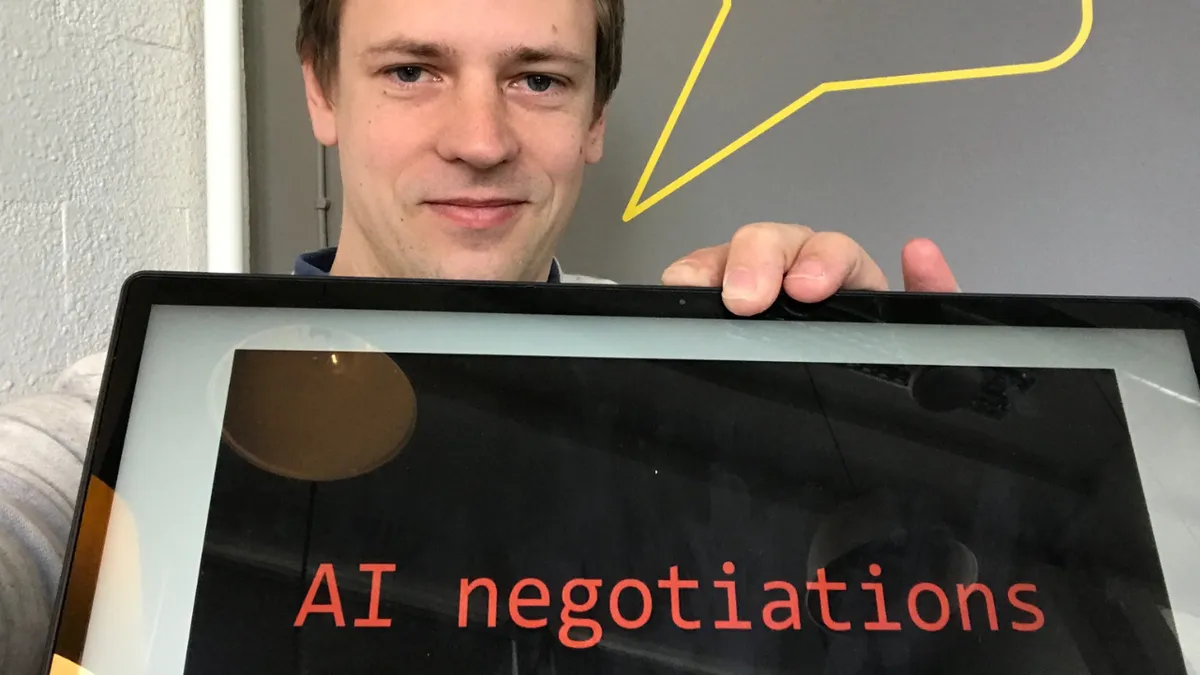
As the author of this article, I should confess that included me. My Facebook like is still there on Kaspar’s post five years ago, but I didn’t actually understand how it would work back then. I only knew that Kaspar could be trusted to spot a good idea and work with great people to turn it into reality.
As Kaspar now explains, people couldn’t see the potential of AI-powered autonomous negotiations at first not just because AI wasn’t yet widely understood but because good negotiation theory has never been widely understood. We think of negotiations just as the high level strategic deals where humans obviously still need to go face to face with each other. But opportunities to negotiate better deals are all around us, if only we had the capacity to research and initiate them.
Where there is complexity, fragmentation, and scale in buying negotiations, a bot is best suited to engage.
In Kaspar’s post five years ago this week, he gave three possible examples of how autonomous negotiations could be used: In HR, procurement, and logistics. All three are now in use.
Pactum specializes in autonmous negotiations for procurement, although also provides it in logistics for companies like Maersk whose direct spend is often fragmented. Meanwhile, Pactum has been using its own technology for internal hiring and salary negotiations. (I negotiated my own contract with the AI.)
So while it’s perfectly normal for startups to pivot through different ideas, it’s remarkable just how accurate Kaspar’s post was five years ago.
In early 2020, Kaspar also wrote one of the first articles for this Pactum blog predicting how chatbots would proliferate and how, by 2023, Pactum would have built out a suite of features to oversee them. As Chief Product Officer, he kept exactly to that schedule.
Kaspar predicts that in another five years’ time, AI bots will be as normalized in the workplace as a dishwasher is in a kitchen. This will require a dramatic mindshift change as everyone becomes promoted to a manager with the capability of directing AI bots equivalent to each person hiring their own thousand strong workforce today.
By enhancing the role of humans in procurement, as well as enhancing relations between their companies and their suppliers, autonomous negotiations is collaborative AI at its very best. When scaled up, it can significantly raise the world’s GDP.
This is not theoretical. Autonomous negotiations is now an established field of AI with a significant and clearly measurable impact that it makes it one of the exciting and promising examples of what AI can achieve.
Watch this space because 2024 is on course to be even more exciting.